At the Ballickmoyler Petty Sessions in Queen’s County (County Laois) on the 16th of May 1902, Joseph Taylor a twenty-four-year-old labourer from Garrendenny, was charged with seriously assaulting Mary Daly, thirty-five, of Clonbrock on the 9th of May by striking her on the head with a hatchet. On the case being called the prosecuting solicitor asked for an adjournment due to the fact that the injured woman could not be found. Her husband John Daly, thirty-nine, stated that she had sold two of his cows in Carlow and had gone away.
A month later on Tuesday the 17th of June, the battered body of John Daly was found in a field beside his house. According to his wife, Daly, who worked as a farmer and as a coal carter, had gone into Carlow the previous day, and delivered coal to Killerig. His wife stated that she had waited up until eleven o’clock for him to come home and then went to bed, sleeping so heavily she did not hear his return. She got up at seven o’clock and saw the horse and cart in their usual place. A short time after she sent her eleven-year-old son to find his father. He returned without any success, and she then sent him in another direction over a stile. The boy came running back and said his father was lying in a field. He then accompanied his mother to the spot where his father was lying dead against the incline of the rising ground. The police at Doonane barrack were sent for. They found evidence of a struggle. There was a wound on the victim’s right temple and under his left eye while the back of his head had been perforated all over by some sharp object. A sprong with blood marks was located in the house, and near the body a portion of a broken sprong was found, while the rest of the sprong was recovered from near a stream not far away from where the body lay. On learning of trouble between Joseph Taylor and the Daly’s, the police arrested Taylor that afternoon and charged him with the wilful murder of John Daly.

The next day, Wednesday the 18th of June, an inquest into the death of John Daly was conducted by Dr. T.F. Higgins, the Queen’s County Coroner. Following an examination of the body at his residence, the jury reconvened at the Crettyard Stores where the inquest continued. R.I.C. District Inspector Hugh Greer represented the Crown at the proceedings. The first witness called was the eleven-year-old son of the deceased, John Daly Jr.
District Inspector Greer. “Did you see your father on Monday?”
“No; he went to Carlow at around four o’clock in the morning with a load of coal.”
“Were you in bed before he returned?”
“Yes.”
“What time did you go to bed?”
“At around half past nine.”
“Where do you sleep?”
“I sleep in a bed in the kitchen with my sister and mother.”
“Do you know what time your father came home?”
“No.”
“Did you not hear the noise of the cart or anything around the house?”
“No.”
“What time did you wake up?”
“I woke up at around seven o’clock and then I got up.”
“Was your mother up before you?”
“Yes.”
“Did she say anything about your father?”
“She told me to go and see was the horse in the field or was the cart in the yard. I went to the field and saw the horse and then came back and told her.”
“What did she say on your return?”
“She asked had I seen my father and I said I hadn’t. She then told me to go and see was he in the field. I went out again and found my father lying on the hill in the field. I went up to him and placed my left hand on his leg, but he didn’t stir, he was cold.”
“What time was this at?”
“I knew it was a few minutes after seven as I heard the Colliery whistle sounding.”
“Were you on your own when you went into the field the second time?”
“No; my sister was with me.”
“When you saw your father didn’t stir what did you do?”
“I went and told my mother that my father was dead.”
“Where was your mother when you told her this?”
“She was in the kitchen; sitting at the fire.”
“What did your mother say to this news?”
“She said nothing but went up to where he was. She stirred him and then said to me he was dead. She then told me to go and tell the police, and I went to Doonane barrack and told the sergeant.”
“Did you go immediately for the police once she told you to?”
“No; I had my breakfast first.”
Eliza Daly, the Daly’s nine-year-old daughter, was next called, but as she did not understand the significance of the oath she was not sworn. District Inspector Greer then said that there was no other witness for him to produce except Mary Daly, and that he understood from questioning her, that the only evidence she could give would be to corroborate the evidence of her son.
Dr Higgins. “Why is she not examined? Is she suspected of any complicity in this?”
District Inspector Greer. “There is a reasonable amount of suspicion of complicity I think; it is the common rumour and every man in the room knows that.”
“Well, every man in the room may know it, but I do not know anything about it. It is strange that in the wire I got from the police they only stated that he was found dead and nothing else.”
“We can examine the sergeant who found the body so.”
Sergeant Michael Conlan was then deposed.
“Yesterday morning John Daly Jr came into the barrack at Doonane around a quarter past ten and said his father was lying in the field and he thought he was dead. I asked him if he had felt the body and if it was cold, and he replied yes. He also said his mother had felt him and had said he was dead. I at once went to the place and found the body lying in a field between seventy-five and eighty yards from the back of the house. The body was on its left side with the head turned towards the south-west. There were wounds on the head and one of his fingers. He had his hand on a bridle and wickers as if he had them in his hand at the time of his death. About ten yards from where the body lay there was a large pool of blood, and near that I found a portion of a sprong. There were in all four pools of blood near the body within a radius of seventeen yards, and all on the side of the body further from the house. The nearest pool was within two and a half yards from the body while the largest pool was about ten yards from it. This ring from the handle of a sprong that I hold was found embedded in the ground by Constable Maher. I examined the body and found it cold and stiff; there was a small portion of lime on the end of the trousers, but otherwise they were fairly clean. I then went into the Daly’s house, and behind the door I found this sprong that I am holding, with as you can see, the iron of it apparently broken. There was a good deal of blood about it as if marked with hands. The body that was viewed by the jury is the body I found in the field.”
Dr Higgins. “What age was the deceased?”
Sergeant Hanlon. “He was about forty years of age.”
There then followed a delay in proceedings caused by the absence of the doctors who were still engaged in the examination of the body. It was remarked that Mary Daly was in the hall adjoining the room if the jury wished to hear her evidence. The coroner stated that he would examine her if she so desired. After a wait of half an hour the doctors arrived. Dr J.S. Lane, Ballickmoyler, was first deposed.
“I conducted a post-mortem examination on John Daly’s body, with the assistance of Dr. McKenna. On his face I found a deep incised wound beneath the left eye one inch in length. Immediately above the left eye there was an incised wound an inch and a half in length and an inch in width. There were three wounds on the forehead: one contused and two lacerated. On the left side of the head there were four lacerated wounds from an inch to an inch and a half in length. On the back of the head there were three incised wounds, each two inches in length. All the wounds penetrated to the bone of the skull. On the right hand there was a slight incised wound on the first finger. On examination of the brain there was an effusion of blood into membranes and the brain itself. There was no fracture of the skull. The external wounds, with shock and effusion of blood into the brain would have caused death.”
District Inspector Greer. “In your opinion Doctor, would this class of wounds have been caused by a heavy instrument or a light one?”
“With a heavy instrument, I would say, as all the wounds were down to the skull.”
“Would it require a considerable amount of force to inflict them?”
“Yes.”
“Would they have been caused by a sharp instrument or a blunt one?”
“Well, some were caused by a sharp instrument and some by a blunt one; the incised wounds were caused by a sharp one.”
“Would the prongs of a sprong have caused them?”
“Yes; the prongs of a sprong would have caused the incised wounds.”
“Could a stone have caused the contused wounds?”
“Yes.”
A Juror. “Was the deceased sober at the time of his death?”
Dr Lane. “I couldn’t say.”
Dr Thomas McKenna was next sworn and was asked by the coroner did he corroborate Dr Lane’s evidence.
“Well, yes, as to the cause of death and nature of the wounds.”
“Why do you not agree as to what caused the wounds?”
“If the man received such a number of heavy blows with a heavy weight, in all probability his skull would be fractured.”
“What do you mean by a heavy weight?”
“It would be inflicted by a heavy instrument.”
“Well, do you not agree as to what caused the injuries?”
“I am under the impression that if it was anything like a heavy weapon firmly held and discharged with any strength or violence it would make more than a laceration on the skull..”
District Inspector Greer. “Could they all be caused by the prong of a sprong?”
“Well, probably.”
“Is there any other instrument more likely?”
“There are so many instruments likely to inflict some of the wounds it is impossible to specify them by name.”
“Would you consider a four-pronged sprong likely to cause them?”
“Well, if a person took a long handled sprong and hit a person on the head, the impetus is not very great, especially if the fork is light.”
Dr Higgins. “That is rather a matter of opinion, and your opinion is no better than that of the jury’s. This is not expert evidence.”
District Inspector Greer. “Would the sprong be likely to cause the wounds or any of them?”
Dr McKenna. “I think so.”
This concluded all the evidence and Dr Higgins then addressed the jury.
“Gentlemen of the jury, this is a terrible case, and we have now gone into it as fully as the evidence procurable allows, there may be other evidence. The wife of the deceased is, I believe in attendance, but for reasons which appear very clear and sufficient, the District Inspector has chosen not to insist on her examination. Of course, if she desired to come forward before you and tender her evidence I would be prepared to take it. I consider this is the proper course under the circumstances. Well, she has not come forward, and that ends the matter. On the evidence before you given by the son of the deceased, John Daly, and the police sergeant and the medical evidence, it is impossible for you to come to any other conclusion than that the deceased came by his death by violence by some person or persons, but who they are, has not been shown by the evidence up to this. However, I hope his identity will not remain a mystery, but that it will be soon cleared up and that he will be brought to justice. A terrible crime has been committed in the midst of a peaceful community, a life has been sacrificed, and it is only human justice at least that the law should be rigorously enforced to make the perpetrator amenable for his cruel act. It is for you, gentlemen, to say whether the case is one of murder or manslaughter, but as there is no person identified with the deed by the evidence it is not absolutely essential to go closely in discriminating. It will be sufficient for you to find according to the medical evidence that death was caused by shock and effusion of blood on the brain, resulting from wounds inflicted by some person or persons unknown. You may if you prefer to add that the act was murder, just as you please, if you wish to phrase it that way. If not you can say he was found dead, and that the wounds were caused as suggested. I think you will all agree to that.”
After the briefest of consultations, the jury returned the following verdict.
“John Daly was found dead, and his death was caused by shock and effusion of blood on the brain, resulting from wounds and injuries wilfully, violently, feloniously and with malice of aforethought, inflicted by some person or some persons unknown.”

The Murder Weapon
Shortly after the inquest concluded, arrangements were made at Doonane barrack for the commencement of a magisterial inquiry into the death of John Daly. The inquiry was presided over by Mr. Robert R. Kennedy, R.M., with assistance from Mr. William A. Cooper, J.P.. Joseph Taylor, who had been detained in the barrack since the previous day, was brought before the magistrates. He was not professionally represented and showed no signs of emotion when the charge of having wilfully murdered John Daly was read out to him. District Inspector Greer conducted the proceedings on behalf of the Crown. The first witness called was a young labourer named William Warren who deposed that on the 16th of June he was engaged in drawing sand from a river about one hundred yards from the Daly’s house.
“I brought two loads of sand to my own house near Newtown Cross, and I passed the Daly’s house coming and going.”
District Inspector Greer. “Were you working by yourself?”
“Yes. there were other men drawing sand there, but I don’t know who they were.”
“Did you see the prisoner, Joseph Taylor, that day?”
“On my second journey, at about three o’clock, I met him between the bridge and Daly’s house.”
“What direction was he going in?”
“He was going towards the house.”
“Did he speak to you?”
“Yes; he wished me a good evening.”
“Had he anything in his hands?”
“He was holding something as if wrapped in a newspaper extended in his right hand. But I couldn’t say whether he had anything in his left hand. I didn’t take too much notice of him.”
“Do you think he had drink taken?”
“I couldn’t say whether he had or not. Thinking about it now, I saw him when I made my first journey for sand, he was then going in the direction of Crettyard.”
Mr Kennedy R.M.. “Did you know the deceased?”
“I did, and I saw him lying dead in his house today.”
Joseph Taylor declined when asked whether he wished to ask the witness any questions.
The next witness called was a widow named Mary Brennan from Crettyard. She deposed that she knew Joseph Taylor since he was a child.
“He often comes into my house to light his pipe.”
District Inspector Greer. “Did he come into your house on Monday?”
“Yes; a dispute occurred between Mrs Daly and himself and after it he came into the house.”
“Had he drink taken?”
“He seemed to have.”
“What did he say when he came into the house?”
“He said he was thinking of his brother who was poisoned, and he said it was Mrs Daly he blamed for it, as it was out of her house the poison came, and when he was leaving he said that it would not be the 1st of July until I would hear noise. He added that I would be there to hear it, but he would not be.”
“Did he warn you not to tell anyone what he said?”
“No; he didn’t.”
Mr Kennedy R.M.. “Do you wish to question the witness, Mr Taylor?”
Joseph Taylor. “No; I do not. What she said was true.”
District Inspector Greer. “I have no further evidence to put forward at present so I would like the prisoner remanded for eight days.”
After formal evidence was given by Sergeant Conlan, Taylor was remanded for eight days.
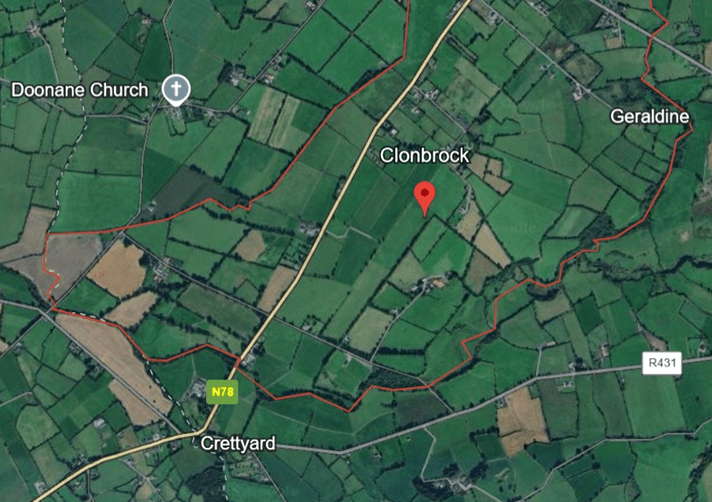
Scene of the Crime
Subsequent to the post-mortem examination, John Daly’s body was waked at his home with many neighbours attending. The funeral was held on Thursday to Kilgorey, and a large number of people accompanied the remains to their final resting place. Mary Daly, who had been subjected to close surveillance by the police, preserved a calm demeanour throughout. John Daly’s brothers and relatives along with his wife’s brothers and friends were present for the burial. In the following days rumour swept the locality that Mary Daly had been arrested but these turned out to be false. That was until half past six on Tuesday evening the 24th of June when she was taken into custody and formally charged with the murder of her husband. She was detained overnight in Doonane barrack, and on Wednesday morning she was conveyed to Ballickmoyler. Joseph Taylor was also driven there under escort from Kilkenny Jail. It had been arranged that proceedings before the magistrates would take place on Thursday, but it was decided to bring them forward a day due to the planned coronation of King Edward VII. (The coronation itself was postponed due to the monarch’s ill health and not held until August)
Proceedings got under way at eleven o’clock before Mr Kennedy R.M. and Mr Cooper, along with their fellow magistrates, Messrs Patrick Brennan and Herbert Warren. The prosecution was conducted by District Inspector Greer. Mr William Byrne, solicitor, appeared for Joseph Taylor, while Mary Daly was not professionally represented. The first witness called was Patrick Scallan, the proprietor of the Crettyard Stores.
District Inspector Greer. “Do you know the prisoner Joseph Taylor?”
“Yes; I do.”
“Did you see him on the 16th of June last?”
“Yes; on that day he called several times to my premises to buy drink.”
“When was the last time you saw him that day?”
“It was about ten past ten that night. He wanted to buy some whiskey and ale, but I refused him as it was after hours.”
“Did you see where he went when he left your premises?”
“He went in the direction of his own house.”
“Did you see him the following day; Tuesday the 17th of June?”
“I saw him at eleven o’clock that morning in the yard beside my premises, I believe he was under the influence of alcohol at the time.”
The next witness was a labourer named Denis Dunne from Crettyard. He deposed that on the 16th of June he was drawing gravel from the river near the Daly’s house.
District Inspector Greer. “Did you see Joseph Taylor that day?”
“Yes; I passed him three times on the road between the Daly’s house and Crettyard. On the last occasion he was carrying a brown parcel and had some bottles protruding from his trousers.”
The next witness called was Thomas Byrne, a brother of Mary Daly’s.
District Inspector Greer. “Do you know Joseph Taylor?”
“I know him quite well. I saw him at my sister’s house on numerous occasions over the last several years.”
“Was your brother-in-law present on these occasions?”
“On most occasions he was, however, I remember two occasions when he was not present and Taylor was in the house.”
“Did you visit your sister’s house at the beginning of this month?”
“Yes; I am not certain of the date; I went after hearing reports that my sister had gone away.”
Mr Byrne. “Did you know this of your own knowledge?”
“I heard it from John Daly himself; he said his wife had just come back.”
District Inspector Greer. “Who was in the house when you arrived that day?”
“When I entered the house John Daly was standing in the centre of the room speaking, Joseph Taylor was standing with his back to the dresser, and my sister was sitting by the fire.”
“Did you hear what John Daly was saying?”
“What I heard John say was something along the lines of. Anyone that likes to come kill me or say anything to my wife and children can do so.”
“Did anyone reply to this statement?”
“Joseph Taylor then said. No one had anything to say to his wife or children.”
“Did you say anything when you heard this?”
“I said to Taylor it was enough for him to be saying things outside, I had heard he had been talking to people, without coming there and saying it to John’s face.”
“What was his reply?”
“I don’t recollect anything further being said as I was not minding much.”
Mr Byrne. “You were not minding a trivial matter?”
Mr Cooper. “These leading questions should not be allowed.”
Mr Byrne. “By whom? All the leading questions are being asked by the District Inspector.”
District Inspector Greer. “I don’t believe I have asked a leading question.”
“I think they are all leading, however I don’t object.”
District Inspector Greer continued with his examination of the witness by asking him when was the next time he visited his sister’s house.
“I next went to her house on last Sunday fortnight; Patrick Kelly, a first cousin of mine was with me, and we arrived at around two o’clock in the afternoon. John Daly and his two children were in the kitchen, and my sister was in the other room.”
“What was the conversation you had with John Daly at that time?”
“I asked him where he had picked up Joseph Taylor the night he brought home his wife and children?”
Mr Byrne. “I object to this evidence. It is all hearsay. My client was not present, and Mrs Daly was in a separate room, and it cannot be proven that she heard what was said.”
Mr Kennedy R.M.. “Sustained. District Inspector, can you take up the evidence as to what happened between the witness and his sister?”
“Certainly, My Lord. Can you tell us what occurred between your sister and yourself that day?”
“After the conversation with John Daly, I went into the room where my sister was, she was sitting at the far side of the room and was alone. I asked her what did she sell the cows for or what did she do with the price of them. I also said it was better for her to get something for her children then to be giving it to Joseph Taylor to drink. She told me the children never asked anything from me, and that it was nothing to me. She did not say anything to me after that.”
Mary Daly. “Didn’t you break all that was in the room?”
District Inspector Greer. “Keep quiet mam.”
Thomas Byrne. “When I was going out of the room she was talking but I could not hear what she said. I don’t know whether she did anything.”
Mr. Byrne. “I think it would be much fairer had this woman being arrested a couple of days ago.”
Mr Kennedy R.M.. “You see, Mr. Byrne, you or I or the magistrates have nothing to do with that. The Crown must exercise their discretion to the best. Mrs Daly, if you wish to make any defence I think it would be better for you to get a solicitor to act for you in this case.”
Mary Daly. “I am not able to say anything at all about it?”
Mr Kennedy R.M.. “That is not the question.”
Mr. Byrne. “It is better not to ask her a leading question.”
Mr Kennedy R.M.. “I am not asking her a leading question. I am telling her what her right is, in her ignorance. I do not want to have it said that the magistrates took any advantage of her silence in the matter. We wish to let her exercise her right and examine any witness.”
District Inspector Greer. “Do you wish to ask him any more questions?”
Mary Daly. No sir, I don’t want to ask him any more questions.”
Mr. Byrne. “I think she said something about breaking something.”
Mary Daly. “Yes I asked him didn’t he break everything when he came into the room.”
Mr Kennedy R.M.. “Mrs. Daly, it is your right to ask him any questions that you want.”
Mary Daly. “Didn’t you break something in the room?”
Thomas Byrne. “I could not say what I broke, I struck an old shelf with my hand.”
“Yes and you broke things and what were you going to do then?”
“I don’t know.”
“Weren’t you making a box to hit me only for…”
“No!”
Mr Kennedy R.M.. “Ask him a question.”
Mary Daly. “What were you going to do after you broke the things in the room?”
Thomas Byrne. “I drew my hand and struck them when I was in a passion. I did not want to strike you.”
“Yes you did.”
Thomas Byrne was then excused, and District Inspector Greer gave his evidence.
“I arrived at the late John Daly’s house at Clonbrock, Queen’s County, at half past two on the 17th of June. I made inquiries into the death of John Daly and at half past three I arrested Joseph Taylor and charged him with the murder of John Daly on the night of the 16th of June. I cautioned him on arrest; he then said that he knew nothing about it and was in bed at ten o’clock that night and there was a man who saw him in Garrendenny that morning. I then handed him over to Head Constable Murphy, who escorted him to Doonane barracks. I continued inquiries into the case and on the 24th of June at six o’clock in the evening I arrested Mary Daly and charged her with the murder of her husband, John Daly at Clonbrock on the night of the 16th of June. I cautioned her and she said nothing in reply to my charge.”
Mr Kennedy R.M.. “Have you any questions Mrs. Daly, for District Inspector Greer?”
“No sir, I am not able to ask him any questions at the present time.”
District Inspector Greer then asked for a further remand of the prisoners so he could produce further evidence. The two prisoners were remanded without consent for bail until the 23rd of July.
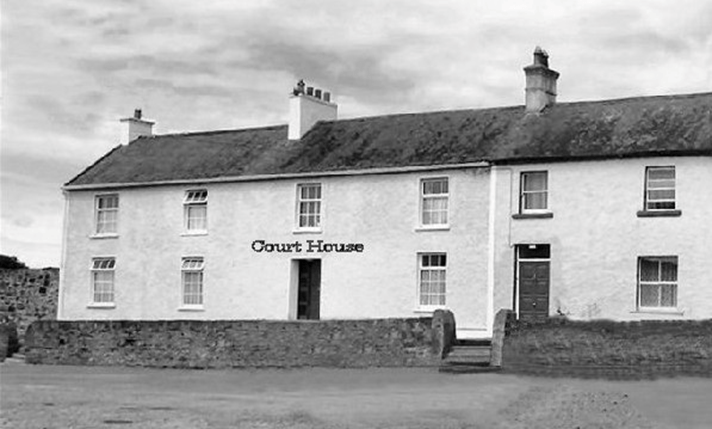
Ballickmoyler Court House
The Magisterial inquiry resumed on the 23rd of July at Ballickmoyler, with Mr. Kennedy R.M. presiding once again. The prosecution was led by Mr. J.H. McLoughlin, the Crown Solicitor for Queen’s County, and District Inspector Greer. Mr. Byrne represented Joseph Taylor, while Mary Daly remained unrepresented. The prisoners were transported to the court under police escort, with Daly arriving from Waterford Jail via Carlow, and Taylor from Kilkenny Jail via Castlecomer. The first witnesses called was John Daly Jr, who repeated the evidence he had given at the Coroner’s Inquest. Following him Head Constable Murphy was deposed.
Mr McLoughlin C.S.. “What time did you arrive at the scene of the occurrence on the 17th of June?”
“At about half past three.”
“And what did you do on your arrival?”
“I examined the body and the surroundings. I was then assigned responsibility for the prisoner, Joseph Taylor, and transported him to Doonane barrack.”
“Did you caution Taylor?”
“No; I heard the District Inspector cautioning him in the usual manner before I took charge of him.”
“Did he say anything to you on the way to the barrack?”
“No; he was quite drowsy; half asleep really.”
“What happened after you arrived at the barrack?”
“At the barrack I told him I would require the clothes he was wearing. He offered no resistance and took them off. While doing so he remarked that they were the same clothes he had on since he was in Kilkenny.”
“Did you examine the clothes after he took them off?”
“Yes; I observed what appeared to be blood stains on the right sleeve of the shirt and on the inside of the left cuff. In his pockets I found the sum of eleven pence in silver and eleven pence in copper.”
“Did you remain in the barrack for the rest of the day?”
“No; I returned to the scene and viewed the body.”
“Can you describe what you saw?”
“The left hand was behind the body with the palm upwards and the fingers slightly bent. The body was then removed and brought into the house. After it was removed I observed a depression in the grass which was slightly blood stained where his head had rested. In the house I counted twelve wounds on the body. I then proceeded to cut a portion of hair of the deceased’s head, and this was sent with the prisoner’s clothes and a blanket to Dr Lapper on the 7th of July. I also took possession of all the clothes worn by the deceased, a coat worn by the prisoner’s brother James and a woman’s shirt, which was found at the head of the deceased’s bed with the blanket I sent for analysis.”
Constable Moses Roche was next called to the stand.
Mr McLoughlin C.S.. “On the 9th of May last had you reason to call to Mary Daly’s house?”
“Yes; I went to her house along with Sergeant Conlon in consequence of a complaint which had been made to me that she had been assaulted with a hatchet by the prisoner Joseph Taylor.”
“Was Joseph Taylor there at the time?”
“No; but he came into the yard when Sergeant Conlon was talking to Mary Daly.”
“What did he say when he came into the yard?”
“He asked Sergeant Conlon did he want him and the sergeant replied for what. Taylor then said. That is the woman there, while pointing at Mary Daly, you ought to arrest. She was the cause of my brother poisoning himself. She sold fowl to Mr Scott and gave me five shillings to go to Crettyard to get drink to kill her husband. She put poison in his tea, but he wouldn’t drink it. I asked him how did she want to kill him and he said. To meet him at the bridge when he would be coming home, to strike him with something and then turn the horse and cart over on him. He then stated that Mary Daly had poison in the house to poison John Daly. He then went into the house and returned with a small bottle which he said contained carbolic acid. This bottle and its contents were handed over to Dr Lapper for analysis.”
“On the 16th of May did you escort Joseph Taylor to Kilkenny Jail?”
“Yes; I did.”
“Did you have a conversation with him while doing so?”
“Yes; I did. He told me that Mary Daly hated her husband and at the time he was in hospital had prayed he would not come out. He then said that Daly would be a comfortable man only for all that he ate and drank on him. He said he was sure he had eaten and drank up to £100 on him. He also said that Mary Daly had put poison in her husband’s tea, and he saw him spitting it up going along the road to the prisoner’s house. He also said that Mary Daly had put poison in his own tea one evening when she thought he was drunk.”
Mr. Byrne. “Did you take notes of these conversations?”
Constable Roche. “I took a mental note of the two conversations. I carry a notebook, but for not entering down unimportant matters. I put down important things, important matters. I had my notebook on both these occasions.”
“And you did not consider them of sufficient importance to take them down?”
“Well, I thought them extraordinary statements and ones that I would not be likely to forget.”
“When did you begin to take mental notes?”
“I always take them.”
“In the course of your duties do you take notes of important statements?”
“I never took a statement like that before.”
“Then you did not consider that important?”
Mr. Cooper. “He didn’t say that he said he didn’t take them down before.”
Mr. Byrne. “You are simply acting as a magistrate here and not representing the Crown although one would be inclined to think you are. Constable Roche, is it your habit to take important statements in the course of your duty?”
“I have never done it since I joined the police.”
“And how long are you in the police?”
“Fourteen years.”
“And you carried a notebook in that time?”
“Yes.”
“Do you enter important statements in it?”
“I enter anything that occurs in the course of my duty.”
Mr Kennedy R.M.. “And you are fourteen years in the police, and an important statement was never made to you?”
“Oh yes, I was engaged in a larceny case.”
Mr. McLoughlin C.S.. “A conversation relative to a larceny?”
“Yes.”
Mr. Byrne. “Is it not the course in important cases to enter statements?”
“I only entered one.”
“You were asleep for fourteen years except for one day?”
“Yes.”
“Where do you carry your notebook, in your pocket or your little handcuff case?”
“Oh, anywhere I like.”
Mr Kennedy R.M.. “Answer the question.”
“I carry it in my handcuff case.”
Mr. Byrne. “And you carried this note in your head?”
“It was no trouble to me to carry it in my head.”
Mr. McLoughlin C.S.. “Where will this cross-examination end?”
Mr. Byrne. “I don’t know but I want to find out.”
“Well, I object. You want to test the credit of the witness by questioning him as to the cases he has been engaged in since he joined the police force.”
“The object of my question is apparent to anybody. I want to know if it is the custom not to enter matters of this kind into his notebook.”
Constable Roche. “A man may or may not enter them in the book. I carry them in my head also.” (laughter)
Mr. McLoughlin C.S.. “You have the fact that he didn’t enter these particular conversations. At the time of the conversation was there anything between Taylor and Mrs. Daly?”
“Yes, there was a prosecution here at Petty Sessions for assaulting her with a hatchet.”
Mr. Byrne. “Another mental note?”
Mr. McLoughlin C.S.. “In your opinion, did you consider that these conversations had any bearing with the assault case.”
“I did not.”
John Daly, the eleven-year-old son of Mary Daly was then called to the witness box. His appearance visibly affected the two prisoners who became fidgety and agitated. Mr Kennedy R.M. said that the boy had made a deposition at the Coroner’s Inquest and was now going to make a further one.
Mr McLoughlin C.S.. “Did you tell all you knew in your deposition the last day?
“No; I did not.”
“After you found your father’s body and before you were sent to get the police what did your mother say to you?”
“She told me what I was to say and to tell nothing.”
“What did you say to that?”
“I said I wouldn’t.”
“And did she say the same to your sister?”
“Yes; on the following Saturday she told us to tell nothing.”
“Now, according to your deposition you went to bed at around half past nine on the night your father lost his life?”
“Yes.”
“Were you awoken from your sleep?”
“Yes, a while after I was woken by shouts coming from the front yard.”
“Were you awakened by any particular voice?”
“Yes.”
“Whose voice.”
“My father’s voice.”
“Did you hear anything he said or shouted?”
“He said to leave him his life.”
“Could you tell from what part of the yard the voice was coming from?”
“Near the kitchen window.”
“Did you hear any other voices?”
“No.”
“What did you do when you heard the shouts?”
“I got up and put on my clothes, my sister was in bed with me and she got dressed too.”
“Did you then go out into the yard?”
“Yes.”
“And who did you see in the yard?”
“I saw my mother over standing by the stable door, where we keep the horse.”
“Was she dressed?”
“Yes; she had her dress and boots on and a shawl over her head.”
“Who else did you see in the yard?”
“Joseph Taylor and his brother James.”
“Did you see your father?”
“My father was lying on the ground near the kitchen window.”
“Were the Taylor’s attacking your father?”
“Joseph Taylor was partly kneeling on the ground boxing and kicking my father.”
“Did your father say anything?”
“My father was moaning and saying to leave him his life.”
“Was James Taylor hitting your father?”
“I didn’t see him hit him. When Joseph Taylor stopped boxing my father James when away in the direction of his own house.”
“What did Joseph Taylor do after he stopped boxing and kicking your father?”
“He caught him by the collar of the coat and dragged him along the ground and across the garden and over the stile.”
“Did you follow him?”
“Yes; I followed him into the garden as far as the stile. I then looked out into the field and saw them for a while before they disappeared. I then heard belting with a sprong, it was the noise of a sprong, like a jingle. I then went into the kitchen.”
“Where was your mother?”
“She was still standing in the yard when I went into the house. She followed me in then and told us to go to bed. She stayed in the house until we got into bed and then I heard her leave the house, closing the door behind her.”
“When did you see her next?”
“The following morning.”
“You described that Joseph Taylor boxed and kicked your father, did James Taylor or your mother make any effort to save your father?”
“No.”
“While your father was being treated in the manner you describe, did your mother or James Taylor say anything?”
“No sir.”
“While your father was being dragged over the stile did he show any signs of life?”
“He did sir.”
“How do you know he had life?”
“He was moaning and telling them to leave him his life.”
“You said he said that before, but did he say it when he was being dragged over the stile.”
“He did sir.”
Mr Cooper. “Did he say it often?”
“He did sir.”
Mr. McLoughlin C.S.. “Did you see anything in your father’s hand when he was been treated like you told us?”
“No sir.”
Mr. Byrne. “You were sworn three times already?”
John Daly. “Yes sir.”
“And each time you promised you would tell the truth?”
“Yes sir.”
“And you concealed the truth?”
“Yes sir.”
“You knew you were perjuring yourself and that you were concealing the truth. How long was it before you went out into the yard?”
“About ten minutes sir.”
“And all that time you heard your father say leave me my life, was he saying it as quickly as he could?”
“No sir.”
“Well, pretty quickly?”
“Yes sir.”
“Did your sister awaken before you?”
“No sir we were both awake at the same time.”
“You said Joseph Taylor was kneeling on the ground, was he kneeling the whole time he was kicking your father?”
“No sir, he was standing up when he was kicking him.”
“What was going on when you went out first, kicking or boxing?”
“Boxing.”
“How long after James Taylor had left before your father was dragged into the field?”
“About a minute.”
“About how many minutes did you spend looking on at this occurrence?”
“About fifteen minutes.”
“And you never spoke a word to anybody the whole time?”
“No sir.”
“Nobody else spoke except your father?”
“No sir. I heard no other voice that night except my father’s.”
“Could the two Taylors and your mother see you in the yard for that quarter of an hour?”
“Yes; they were looking at me.”
“Was Joseph Taylor kicking your father as hard as he could?”
“Yes sir.”
“Was he kicking him in the sides, stomach and everywhere as hard as he could?”
“He was kicking him in the back and in the head.”
“And he spent a quarter of an hour at this, kicking him as much in the back as in the head and in the head as much as the back?”
“Yes sir.”
“He spent half the time kicking him in one and the other half kicking him in the other?”
“He did sir.”
“Did your father bleed a great deal from the kicks in the back and in the head?”
“I could not see him bleed any.”
“Was it very dark at the time?”
“No sir it was not very dark, but it was a dark night. The moon was not shining and there were no lights about the house or yard.”
“How long did you remain in the garden?”
“About five minutes.”
“What were you doing all that time?”
“I was looking into the field.”
“Didn’t you not say you could not see anything in the field?”
“I was listening.”
“Had Joseph Taylor a sprong when he was dragging out your father?”
“He got the sprong in the garden, he had it in hand as he was dragging out my father.”
“Did he stop in the garden to take the sprong with him?”
“No sir, it was outside the stile.”
“Did you see it there before Joseph Taylor brought out your father’s body?”
“No sir.”
“When you went into the house did you go to bed at once and fall asleep immediately?”
“I did and my sister fell asleep too.”
“When did the police find out that you had more to tell that you had been hiding?”
“On last Saturday morning.”
“Who did you tell?”
“I told my Uncle Thomas and he told the police.”
“Was your uncle talking to you constantly about the case?”
“He use not talk often but he talked sometimes.”
“When did you go to live in your grandmother’s?
“Two days before my mother was taken.”
“You used to be sometimes talking to your Uncle Thomas about the case when you went there first?”
“Yes.”
“Would you be talking to him a couple of times a day?”
“No, about once a day.”
“Would you have a long conversation about it?”
“Yes sir. I also spoke to my grandmother about the case. Some days she would not speak to me about it and other days she would.”
“Trying to find out what you knew?”
“Yes.”
“Did you speak to anybody else?”
“No.”
“On the night your father was killed did you go to any of the neighbouring houses?”
“No sir.”
“Why didn’t you shout or go and get help?”
“My mother would not let me.”
“Sure, she was not holding you.”
“She was with me.”
“Why did you look on and not try to save him?”
“I could do nothing.”
“You did not roar or anything?”
“No.”
Mr Kennedy R.M.. “Why didn’t you go for assistance?”
“I did not go because my mother was there and would not let me.”
Mr Byrne. “You believed she would not let you?”
“Yes sir.”
“She did not try to stop you, and you did not go yourself.”
“Yes sir.”
Mr Kennedy R.M.. “Nor did she ask you to go for help?”
“No sir.”
Mary Daly. “Who put you up to give all this false evidence since last court day?”
“No one at all.”
“Who told you to say all these things here, to give false evidence, was it the police who put you up to it?”
“No.”
“How could you think of all these things and make them up yourself if no one put you up to it?”
“No one put me up to it.”
“Oh, his uncle or his grandmother threatened to kill him if he didn’t give false evidence. They should have given him something good to tell. He walked into court and told a lot of lies.”
Mr. McLoughlin C.S.. “Did anyone threaten to kill you since the last court day?”
“No sir.”
Mr Cooper. “You said in reply to Mr. Byrne that you perjured yourself, why did you perjure yourself when you came up here before?”
“I was afraid.”
“Who were you afraid of?”
“I was afraid of the Taylors.”
Mr. Byrne. “Do you know that your mother and James Taylor were not on good terms for a good while before this occurrence?”
“Yes.”
“And he would not go to your house when your mother was there?”
“No sir.”
Mr Kennedy R.M. “There is no charge against James Taylor at all. Mrs Daly, do you wish to ask the witness any questions?”
“I have no use in examining him because he was put up to tell lies for the last week.”
Mr Kennedy R.M. to John Daly. “Were you threatened by anyone when you were giving evidence last court day?”
“Yes, by my mother.”
“What did she say?”
“She told me not to be telling lies or she would kill me.”
Mary Daly, rising from her seat. “I beg your pardon gentlemen. I never said a word to him since he came into court. I never spoke a word to him since I was arrested. Sure, that is no evidence.”
At this stage Mary Daly resumed her seat and began to cry. Head Constable Murphy asked he if she required some water, but she made no response.
Mr Kennedy R.M.. “This woman seems in a weak condition. I think we should adjourn for ten minutes and let some air into the court.”
Upon resumption, Mr. Byrne addressed the court on behalf of Joseph Taylor, arguing that a prima facie case had not been established against him.
“With regards to the blood stains found on his shirt it was not found to be human blood. The analyst could only swear it was mammalian blood; it could not affect the case any more than the conversation about killing Daly could affect it. With regard to young Daly’s evidence, it has been laid down in court that a reasonable amount of credit must be given to the evidence of witnesses. How can we give that to the little boy who stated he came forward three times and perjured himself. At a previous court the worships complimented him on his intelligence, but how can they place credence in evidence given that way, evidence of a boy who acknowledged that he deliberately perjured himself. The excuse was given further, that he was afraid of the Taylors, he admitted, was an insult to the intelligence of the court, the Taylors had said or done nothing to him since the 16th of June, and his explanation was really nonsensical. This evidence he has given is wholly incredible. This young fellow was lying in bed for ten minutes listening to his father cry out Leave me my life. Then he got up and dressed himself, he did not say whether he looked at himself in the looking glass or brushed his hair (laughter) before he went out. You can hardly believe that he would go out and look on calmly while his father was being murdered. His little sister, whom the Crown in their wisdom did not examine, was there too, and I suppose she will be kept as a surprise packet for some future trial if there is to be one. This boy was standing looking at his father being kicked in the head and back with great force, although from the evidence of the doctors there were no marks except on the head and one finger; there was not one single bruise found on the body by the doctors who carried out a post-mortem. I submit that the boy’s evidence is incredible and on which should not form the basis of sending Joseph Taylor to trial for murder. If a man were being done to death in the manner described by the little boy, was it likely he would keep repeating himself like a parrot, the same cry. Leave me my life. Another incredible statement was that during the whole occurrence nobody said anything, I submit that this was most improbable.”
After addressing other issues, Mr. Byrne requested that their worships determine there was no prima facie case against Joseph Taylor and not send him for trial.
Mr. McLoughlin C.S. then stood and presented his closing argument for proceeding with the trial of the two defendants.
“Mr Byrne has commented on the evidence of young John Daly; this evidence has been uncontradicted and you as magistrates are bound to act on that uncontradicted evidence. True it was given by piecemeal, but he has given the reason for doing so and his evidence was borne out by circumstances. The coat the deceased was wearing on the night of his murder corroborated in a most remarkable way the statement that that he had been dragged through the yard and garden to the place he was found the following morning. If the killing had taken place on the grass he would not have had all that mud on the back of his coat. The medical evidence showed that a murder had been committed and the question was who did it? Is there sufficient evidence to connect the prisoners with it? I submit that there is an overwhelming amount of strong evidence, and I ask you to return the prisoners for trial at the next assizes for the Queen’s County.”
After a short discussion with his fellow magistrate, Mr. Kennedy R.M. stated that both prisoners would be sent for trial at the next assizes. Mary Daly was ordered to be committed to Tullamore Jail, and Joseph Taylor to Kilkenny Jail, pending their trial at the Winter Assizes.
After his removal to Ballickmoyler police barracks to await his transfer to Kilkenny, Taylor was placed in the lock-up. Shortly afterwards he was found by a barrack orderly bleeding profusely from wounds to his head and face. The walls of the cell were splattered with blood. Taylor was unconscious and a doctor was sent for immediately. After being treated he remained in the police barrack overnight and was then deemed well enough to be transferred. A sharp stone was found to be the weapon with which he had inflicted his injuries.
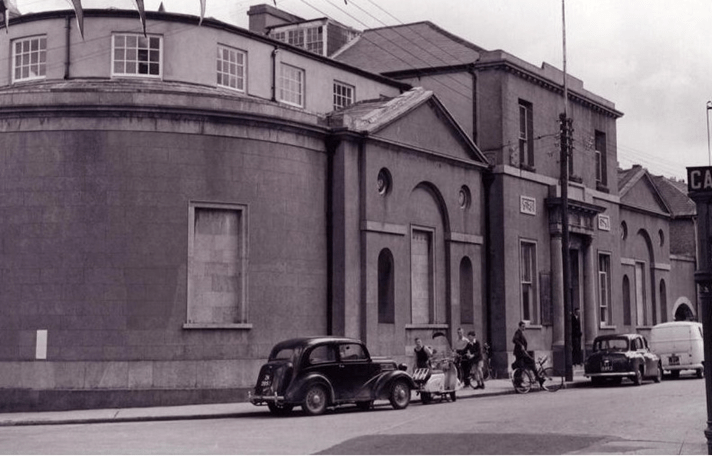
Port Laoise (Maryborough) Court House
Mary Daly and Joseph Taylor were initially scheduled to be tried together for the murder of John Daly at the Queen’s County Winter Assizes held in Maryborough (Port Laois). However, on December 12th, after reviewing a defence application, the presiding judge, Mr. Justice Kenny, decided against the prosecution’s preference and ordered separate trials. Joseph Taylor’s trial commenced that day, with King’s Counsel’s Mr. J. Wakely and Dr. J.B. Falconer representing the prosecution. Mr. David J. O’Brien, under the instruction of Mr. Byrne, was appointed as Joseph Taylor’s defence counsel. Mr. Wakely KC was the first to present his arguments.
“The motive for this crime was a low and brutal one. The motive of the man, who had undoubtably been misconducting himself with the female prisoner for some considerable time and whose own statements left no doubt whatsoever as to this question, was one fortunately rare in this country, as were the circumstances of the relations between the two prisoners. The murdered man lived at Clonbrock and was a coal carrier. The male prisoner lived about three hundred yards from the Daly’s house. The prisoner on the day in question had been drinking heavily, as the Crown suggest, getting up that false courage which was necessary for such a desperate deed. On the day of the murder the prisoner was at the deceased’s house with Mary Daly between two and five o’clock. The children of the deceased had been put to bed at half past nine the night of the murder of their father; they were awoken subsequently by hearing shouts. They ran out into the yard, and there they saw the prisoner kicking and boxing their father, their mother standing by at the time. They heard their father say. Leave me my life. Then they saw the prisoner dragging the body of the deceased man across a garden and into a field at the back of the house and the elder of the children heard the ring of a sprong, which was used, the Crown submitted, on the unfortunate man Daly by the prisoner. The police found the body of the murdered man the next day and he had been treated in a brutal and revolting manner. James Taylor, brother of the prisoner, was in the yard for a short period while Daly was being attacked, but the Crown believe he had gone there to take his brother home, or they would have placed him in the dock too.”
John Daly Jr was then called, and he repeated the evidence he had given on the last day of the magisterial inquiry. But before he did he was asked by Mr Wakely KC whether he had seen Joseph Taylor on the 16th of June.
“Yes; I saw him at around four o’clock with a parcel of meat in his hand wrapped in brown paper.”
“Was he in the habit of calling to your house?”
“Yes for a long time, especially when my father was away.”
“On the 16th of June did he go into the house with the parcel?”
“Yes; I followed him in and stayed there for five minutes before going out into the garden. I then heard the frying of meat.”
“When you went back into the house what were Taylor and your mother doing?”
“They were sitting by the fire whispering.”
“Did your father own a sprong?”
“He owned two sprongs at that time, one was a new one.”
“Do you recognise this sprong?”
“That is my father’s old sprong which was kept behind the kitchen door. I recognise it because of the black ring around the handle, although one of the prongs had been broken off it before my father was killed.”
“Do you remember going to Castlecomer shortly before your father’s death?”
“Yes, my mother took me and my sister to Mrs. Doomers and on the second day we were there Joe Taylor came and stayed about four hours. Mrs. Doomer said something to my mother and we left. We went about a mile outside Castlecomer and stopped in a cattle house for about two and a half hours. Afterwards my father came with a horse and cart and took us all home.”
Mr. O’Brien. “Are these your own memories or has anybody told you what to say?”
“I have got a good memory, and I would not lie because another person told me to.”
“But you have sworn lies before, you told Mr. Byrne that you never saw the prisoner strike your mother and afterwards before the magistrates you swore you had seen him strike your mother.”
“I swore those lies because I was afraid of the Taylors.”
“And you are not afraid of them now?”
“No; because I don’t live near them anymore.”
“Do you recall your father ever attacking your mother?”
“I remember him attacking her on the Saturday night before he was killed and putting her, myself and my sister out of the house.”
Mr. Wakely KC. “Do you recall your mother ever attacking your father?”
“I remember her attacking him with a hatchet one night.
Mr. O’Brien. “Do you remember Joseph Taylor cleaning your father’s wounds that night?”
“I don’t.”
Mr. Wakely KC. “Was that the only occasion your mother attacked your father?”
“No sir, she attacked him often and on one occasion she sent me to get my Uncle Tom to come down and beat my father, which he did.”
“Did anyone threaten you between the time of your father’s death and the arrest of your mother?”
“My mother threatened to kill me if I said anything.”
John Daly’s sister Lizzie was next examined, and she corroborated her brother’s evidence. The trial was then adjourned until the following morning.
The first witness on the second day of the trial was R.I.C. Sergeant Conlon who gave evidence to the finding of the body of John Daly in the field on the 17th of June. He was then cross examined by Mr O’Brien B.L..
“On the Saturday night before he was murdered, had you cause to arrest John Daly?”
“Yes, I arrested him for turning out his wife and children from his house. He was under the influence of drink at the time.”
The next witness called was Professor Edwin Lapper who analysed the articles sent to him by the police.
“I made an analytical examination of the various articles forwarded by the police. On the trousers of the prisoner, I found in all eleven stains of blood, the largest of which was one inch in diameter. There were ten to fifteen bloodstains on the shirt sleeves, one of which was two inches in length and one and a half inch in breadth. There were also bloodstains on the stone and seven human hairs, two of which corresponded exactly with the specimens of the murdered man’s hair as supplied by the police. The bottle sent for analysis contained about two fluid ounces of carbolic acid, which is a most deadly poison, half an ounce would be enough to kill any man.”
Mr. O’Brien. “Could you determine whether the bloodstains were human blood?”
“There is no means at present of ascertaining whether the stains were that of human blood or not.”
Dr Lane, who had carried out the post mortem examination on the body of John Daly, was then called.
“Immediately beneath the left eye there was a deep incised wound about one inch in length and one and a half inches in breadth. On the forehead there was two lacerated and one contused wounds. On the left side of the head there was four lacerated wounds, from one to one and a half inches in length. On the back of the head there was three incised wounds about two inches in length. There was also a slight wound on one of the fingers on the right hand. The wounds to the head were all to the bone of the skull. On the removal of the top of the skull, I found an effusion of blood to the brain, death was likely to follow very quickly. The sprong was likely to have caused the incised wounds and could have also caused the lacerated wounds, and if the stone, used flat, would likely have caused the contused wound and a lacerated wound if the edge were used.”
Thomas Byrne was next examined, and he repeated the evidence he had given at the magisterial inquiry in July. Mary Byrne, the mother of Mary Daly, was next to take the stand. She stated.
“One day in May, Joseph Taylor called to my house and said it was from my daughter’s house that the poison came which had poisoned his brother. As he was leaving he said that it would not be the 1st of June that I would hear noise, and that I would be here to tell it and he would not.”
The prosecution’s final witness was Mr. Patrick Kelly. He testified that while he was ploughing at the Taylors on May 17th, Joseph Taylor confided in him that Mary Daly was offering him food, drink, punch, and money to kill John Daly. Additionally, Mr. Kelly reported that Taylor implied there were inappropriate relations between himself and Mary Daly. Evidence of the attempt by Joseph Taylor to kill himself at Ballickmoyler police barracks on the 23rd of July was then entered on the record, closing the Crown’s case
The first witness called for the defence was a surveyor named P.J. Griffin, who stated that he had made a survey of the grounds over which it was alleged that Joseph Taylor had dragged the body of John Daly. Mr Griffin was of the opinion that it would have been impossible for Taylor to have done so. James Taylor, the prisoner’s brother was then called to the stand.
Mr O’Brien. “When was the last time you saw your brother Joseph on the 16th of June?”
“At eleven o’clock that night, I was in bed at the time and he came in and got in beside me. I fell asleep but when I woke in the morning he was still beside me.”
“What was your relationship with the Daly’s like?”
“I was on good terms with John Daly but not with his wife owing to the trespass of cattle.”
Dr. Falconer KC. “Were you in Daly’s yard on the night of June 16th?”
“I was not, if I had been there and witnessed my brother kill John Daly I would admit it.”
“When were you last in Daly’s yard?”
“On the morning of the 16th, I got a loan of a sprong.”
“What was the relationship between your brother and Mary Daly?”
“I didn’t know what terms they were on, but I now believe there were immoral relations between them.”
Sarah Jane Taylor, sister of Joseph and James Taylor, was called to testify next.
Mr O’Brien. “Did you see your brother Joseph on the 16th of June last?”
“Yes; he had his breakfast around nine o’clock and then went out, and I saw him later that morning in Crettyard.”
“Was that the last you saw of him that day?”
“No; he came back to the house between two and three o’clock and stayed for a while.”
“Did he have his dinner at home?”
“No; he did not.”
“When was the last time you saw him that day?”
“At about half past ten that night. He came into my room and asked me where he could get a candle. I told him where and after he lighted the candle he went into the kitchen for about five minutes before going to bed.”
“Did you see him on the morning of the 17th of June?”
“Yes; I saw my two brothers in bed at seven o’clock the next morning when I went into their room to get milk for the breakfast.”
This evidence concluded the second day of the trial and the defence’s case. The court was then adjourned until the following Monday morning, the 15th of December.
On the resumption of the trial that morning Mr. O’Brien addressed the jury on behalf of the defence, focusing first on the bloodstains found on Joseph Taylor’s clothes.
“The jury will remember the attack on Mary Daly by the prisoner in May last, the bloodstains may have come from that disagreement. He might have got the bloodstains from some of his various occupations amongst the cattle on his mother’s farm, or he could even have got them while in the butcher’s shop in Crettyard where it was sworn he had purchased a quantity of meat on the day of the murder.”
Mr. O’Brien subsequently presented the jury with his analysis of the testimony provided by young John Daly.
“Young Daly swore he saw Taylor kick his father, yet there was not the slightest stain on the boots worn by Taylor. With regard to the children, the true account of their knowledge is to be found in their first statement to the police that they knew nothing about it. As to the first deposition made by John Daly, the reasonable view to take on his evidence was that he knew nothing about the matter at all. In his second deposition he admitted under oath that he had sworn lies, and yet this is the witness which the Crown relies on. It would be unsafe for the jury to act on such evidence.”
Dr. Falconer KC offered a rebuttal for the prosecution and then Mr. Justice Kenny issued his charge to the jury.
“Counsel for the defence has displayed skill, tact, and judgement in the case for the defence, and every point put before the jury, and every argument that good judgement could present. There is no doubt as to the relationship which existed between the prisoner and the murdered man’s wife. There is no reason to doubt that he was her paramour. There was murder in the air five weeks before this occurrence and Mrs. Daly had gone so far as to put poison in her husband’s tea and suggested to Taylor that he should murder him. Taylor has at first refused to do so, but it is for you to say if he had, while talking in low tones to Mrs. Daly at the fire on the evening of the murder, consented to do the work which this temptress wished him to do.”
His Lordship then reviewed the main articles of evidence presented by the prosecution and the defence before closing with the remarks.
“It was most shocking and horrible that the woman Daly on the morning of the 17th of June sat down coolly and calmly to breakfast knowing that her husband was lying dead in a field only seventy-seven yards away, and that it was only after eating breakfast that she made any attempt to communicate to anyone the intelligence that her husband was dead.”
The jury retired to consider their verdict and returned sixty-five minutes later with a verdict of guilty.
Mr Justice Kenny. “Has the prisoner anything to say as to why the sentence of death should not be passed on him?”
Joseph Taylor. “I am not guilty. I am an innocent man; that is all I have to say, a very innocent man in the matter, My Lord.”
“The crime of which you have been found guilty of is a most heinous one, the murder having been committed under shocking circumstances, and in the presence of the murdered man’s children. You will have more time to make peace with God then you allowed poor John Daly, and I ask you to avail of it, as I would hold out no hope of mitigation of the sentence I am now about to pronounce on you.”
Justice Kenny then assumed the black cap and sentenced Joseph Taylor to death by hanging at Kilkenny Jail on the 7th of January 1903.
On Thursday the 18th of December the trial of Mary Daly opened, despite the efforts of her defence counsel Mr. Annesley H. De Renzi, to have it postponed until the next assizes due to the negative publicity following the trial of Joseph Taylor a few days earlier. Mr. Justice Kenny insisted that the trial proceed. The Crown was once again represented by Mr. Wakely KC and Dr. Falconer KC. Mr Wakely KC opened the case and presented evidence substantially similar to that which was presented at Taylor’s trial. The court was then adjourned at 6.30 p.m. until the following morning.
When the court resumed, Mr De Renzi, addressed the jury.
“It is my duty to perform one of the most responsible duties that can ever fall to the lot of an advocate, to plead before a jury of his fellow countrymen, for the life and liberty of the woman who stands charged before this court. But at the same time the responsibility which rests on me is a light one compared with the responsible duties that rests on you to bring in a verdict of life or death. The responsibility is even more enormous in this case above all others given the atmosphere of prejudice which has been aroused in reference to this case, owing to circumstances completely out of your control and for which you bear no responsibility for. My learned friend, Mr. Wakely has prayed and besought you to banish from your minds all references to John and Mary Daly and the Taylor family. I am confident that you are conscious of the solemnity of your oaths and that you will treat the evidence of witnesses without fear, favour, or affection. It is not your duty to deal with the moral aspect of this case. The woman is charged with the murder of her husband, but it has also being introduced that she is guilty of an offence against the laws of God and man, shameless and brazen adultery. That is a matter for the Matrimonial Court, where the offence of a wife against her husband is investigated. It is very easy to make charges of this kind against a woman. Let a woman, and especially a married woman, have a friend who is a man and people are ready to throw stones at her and cast aspersions upon her virtue. In another tribunal a woman would have an opportunity of coming forward and refuting the charges made against her.
This is not a court of morals. There is only one issue before you, and that is did Mary Daly aid and abet anyone in the murder of her husband John Daly on the 16th or 17th day of June last. If Mary Daly was a weak woman, that is a matter for herself, her conscience, and her God. If this were a charge which could be brought against her as suggested, one day, as sure as the sun rises every morning, she will have to answer for it before the greatest of Judges, before whom all hearts are open and from whom no secrets are held. You must only judge on the facts of this case of which the woman is charged with.
It has been stated that Mary Daly gave Joseph Taylor money to commit this crime, but there are no facts to prove that even a penny passed between them. The prisoner’s brother Thomas was asked a question on this very point, and he said he never knew of any money passing between them. With regard to the statement about the overturning of the cart, no evidence has been given to substantiate this claim, there was no evidence to show she had given him any drink. With reference to what was alleged to have happened in Castlecomer, who could have been a better judge of that then the husband? When John Daly went to Castlecomer, had he any suspicion aroused, all was dispelled when he went to the house, put out his hand to his wife and brought not only her and his children, but Taylor home in his cart. They then spent the night in Daly’s house together, including Taylor the supposed paramour. On John Daly’s way home on the night, he was killed he was said by one witness named Doogue, to have been under the influence of drink. Assuming that he drove his cart into the yard and met Taylor coming from his house, the evidence has shown that Taylor had consumed a large amount of drink that day, the two were likely to be excited and argumentative. Perhaps Daly imagined that he had been tricked all along about what was occurring between his wife and Taylor. Did John Daly, in a fit of righteous anger, strike Taylor? Did he commence the quarrel? We do not know. Is it improbable that he did? Perhaps seeing the man coming from his house without explanation, was it likely that he would quietly pass him by and bid him goodnight? Take a man in Taylor’s position, sodden with drink as suggested by the Crown, was it not likely between two powerful men in that condition the fight would be a deadly one?
The next you heard was that little Johnny Daly wakes up and hears the noise of the fight, and his father’s voice, but he doesn’t know how long it has been going on. You might ask me what Mrs. Daly was doing out in the yard that night. What brought Johnny Daly out? Was it not through astonishment at what he had heard? I submit that Mrs. Daly went out under the same feelings. She did not take an active part in the attack on her husband, or lay a hand on him, in fact if you look at the map she was in the farthest away place from where John Daly was stated to have been beaten. I ask you to say that it is not improbable that the same cause which brought the Daly children out, brought out their mother too. It had been asked why Mrs. Daly did not attempt to help her husband, but why didn’t Johnny Daly, while the boxing and kicking had been going on, why didn’t he help?
There is evidence of mental weakness in the Byrne family, a sister of Mrs. Daly has been confined to an asylum. Imagine the feelings of this woman when she went outside and saw her husband on the ground; the spectacle of cruelty as described by Johnny Daly, it must have been a terrible one. This strong man Daly, a man of thirteen stone, overcome by the man Taylor. I do not know what Taylor’s physical proportions are, but at any rate, if Daly was on the ground Taylor must have been having the better of it. It would require some courage and mental force to interfere in a quarrel of that sort. James Taylor, man though he is, had not the courage to interfere. Would you expect a woman, much more physically weak and perhaps mentally weaker than James Taylor, to have the courage to rush in and interfere?”
Mr. De Renzi then quoted the Archbold book of law which set out the scope of aiding and abetting in a criminal act.
“There is no proof that the prisoner had aided in concert with Joseph Taylor on the occasion. It was certain that the death did not occur in the yard, and after the sounds were heard in the field, the prisoner and children went back into the house. Whoever finished Daly, finished him in the field, when Mrs. Daly could render no assistance, good, bad, or indifferent. When the Crown produces a case and asks you to pronounce a verdict on the issue of life or death, I think you will agree with me that it is their duty to produce evidence which would assist the jury. The children made statements which the afterwards went back on. It is the business of the police to unravel the thread of every crime. Why was James Taylor not placed in the dock and charged with participation in the offence? What did Mrs. Daly do more than James Taylor? Was it because, forsooth, that the latter ran away, that he knew nothing about it? James Taylor was precisely in the same position as Mary Daly with the exception that he is free, and she is in the dock. I beseech you as you yourselves will be one day judged; to consider the verdict in this case and I hope the light of God will illuminate before your eyes the darkness of that terrible night.”
Dr. Falconer KC then rose and replied on behalf of the Crown.
“Everyone should feel pleased that the prisoner in the dock has the services of an advocate who can speak for her so ably. Any man with the ordinary attributes of humanity would feel for this unfortunate woman in her present position. The case for the Crown is simply that she was a wife unfaithful to her marriage vows. History or romances gave no such example of a forgiving charity as that of John Daly. No stronger evidence could be given in this case than the conduct of the woman on the morning after the murder, when she got up and got the breakfast and then sent the children with lies on their lips to the barracks. You twelve men in the jury box are the real protectors that society has got against crimes like this. The whole merits of the Constitution are centred on twelve honest men, like yourselves, who are put in a box to give an honest verdict according to their oaths. Your verdict is not a verdict of vengeance, but a verdict to protect yourselves and society against similar crimes.”
His Lordship Justice Kenny then charged the Jury before sending them out to consider their verdict.
“You have been addressed with great ability by counsels on both sides and I join with them to ask you to dismiss from your minds anything which you may have heard outside the evidence heard in this case. The essence of the charge against the prisoner was that of malice aforethought, otherwise the indictment would only be one of manslaughter. There may be two actors in such a crime, the one who actually strikes the blow and the one who aids and abets in the crime. If you believe the children that she was concurring in the crime, then there was ample evidence that she aided and abetted in the murder. The theory put forward by her counsel is that she went outside when she heard the noise, just as the children did and that she was an agonised spectator to the occurrence. If you believe that, she is not guilty. Anyone present might become the spectator suddenly of a drunken fight or quarrel coming home any night, and if he or she remained a paralysed spectator of the scene, such a person would not be guilty of participation. If you believed this, and after seeing her husband beaten to death that she went back into the house until morning, you could give her the benefit of such a theory.
Now, was there any motive for the crime, and what were the relationships of the parties concerned? She is entitled to credit for taking care of her children, there is evidence from little Johnny Daly that he saw his father hit his mother once with a sprong although he was portrayed as a quiet, industrious, and sober man. Then we have the assault on the prisoner by Joseph Taylor. The prisoner’s counsel asked you to dismiss the insinuation of immoral relations between the prisoner and Taylor, but the perfidy of the man with her at Castlecomer is sufficient proof that she was not true to her wedding vows. It is idle to say that such relations were innocent. After the Castlecomer incident, John Daly and Taylor stayed up together that night, apparently friendly. Daly may have been a strong man, but mentally he appeared to be weak. We have also the conversation between the prisoner’s brother, Thomas Byrne, John Daly, and Taylor, from which it would appear that stories had been going around. Yet there was no indignant repudiation by the prisoner as might have been expected, she merely told her brother to mind his own business. The last seen of John Daly was at quarter to eleven, and nothing was known of him until the children came on the scene. Assuming that the prisoner’s statement was true, that she did not know whether her husband was dead or not, the incriminatory statement on the 9th of May by Taylor that she was trying to get him to kill her husband was not denied by her. The children have undoubtably made contradictory statements, but the admonition Whist! Or I will kill you no doubt had its effect on those poor little creatures.
Though no defence of lunacy was set up, it was suggested by counsel that having a relative in an asylum indicated some mental defect, but in any of the interviews or other acts deposed to there was no proof of lunacy. The child stated that after she brought them back to bed she again went out, and the awful presumption is possible that she assisted in the completion of the deed. Was it an act that night of an innocent woman going to bed without seeking the aid of priest, doctor, or policeman.”
Finishing his address His Worship said.
“I can hardly see how you can even reduce the charge to manslaughter.”
The jury were then sent out and returned fifty-five minutes later with a guilty verdict. Mr. Justice Kenny then asked Mary Daly if she had anything to say why the sentence of death should not be passed upon her. Looking forward in a dazed manner, she clutched the bars of the dock, shaking, she attempted to speak but was unable to do so. His Lordship, having paused to wait for a reply, then continued.
“Mary Daly, a jury of this county after a long and anxious consideration, have found you guilty of the awful crime of wilful murder. They have accompanied their verdict with a recommendation to mercy, which I will forward to the proper quarter. Already another jury have returned a verdict against Joseph Taylor. I feel bound to say that I concur in both verdicts. How far you took an active role in the doing of the deed that deprived your husband of his life is impossible to say, but there can be no question that you incited to that crime. It remains for me now to pass on you the dread sentence of the law, and I entreat on you during the time you are in this world to make your peace with the great Being whose laws you have so outraged. (Assuming the black cap) The sentence and judgement of this court, and it is ordered that you be taken to the place of execution in the jail in which you will be confined, and then and there, be hanged by the neck until you are dead and that your body be buried within the precincts of the prison and may almighty God have mercy on your soul.”
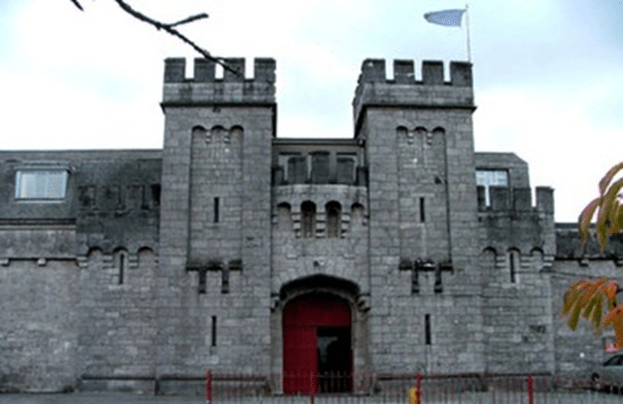
Tullamore Jail
A week later, it was announced that the Lord Lieutenant, William Ward, had reviewed the jury’s appeal for clemency. However, he determined there was no basis to commute the sentence, and thus, Mary Daly’s execution would proceed as scheduled on the 9th of January.
Joseph Taylor was executed at eight o’clock on the morning of the 7th of January in Kilkenny Jail. He made no statement on the scaffold and witnesses present later said he accepted his fate with resignation and went to his death with wonderful calmness.
Two days later on a raw and cold morning in Tullamore Jail, Mary Daly walked in procession to the scaffold, praying loudly on the way, on the scaffold itself, she continued giving responses to prayers. At eight o’clock the prison bell announced to those outside the jail that the sentence had been carried out. She was buried in a corner of the prison yard. Several years later her body was exhumed and buried in the Paupers graveyard on Arden Road in the town. In the 1930s her body was once more exhumed and brought for burial to her home county of Laois by two of her surviving brothers.
This Story was first published in my book Lady Killers.
 Pat Doran Author
Leave a comment