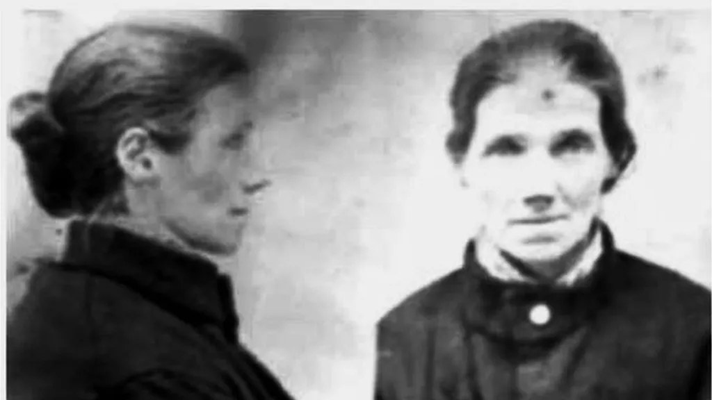
Sarah Anne Pearson
Alice Pearson, who was in her mid-seventies, died on the 27th of June 1904 in the village of Richhill County Armagh. Her son Isaac was jailed a month after her death for the rape of a young woman. While in prison he asked to see the Governor claiming he had something important to tell him. At the meeting he told the Governor that he had a dream in which he saw his mother poisoned by his sister and his wife. Acting on this information the police exhumed the body of Alice Pearson on the 7th of November, and an autopsy was performed on her. The results showed extreme high levels of both mercury and strychnine poisoning. An arrest warrant was promptly issued for Agnes Black, the daughter of Alice Pearson, and for Sarah Anne Pearson, the wife of Isaac Pearson. Both women had left Richhill in the months following the death of their mother/mother-in-law.. Eventually Agnes Black, who was pregnant at the time, was arrested in Wallsend, England and Sarah Anne Pearson in Montreal, Canada. Both women were returned to Armagh to face the charges against them. On the 21st of February 1905 a magisterial inquiry was held into the death of Mrs Pearson, and on its conclusion, the two women were returned for trial on the capital charge of murder to the Armagh County Assizes.
The case commenced on the 9th of March before Mr. Justice Wright at the County Courthouse in Armagh. The Solicitor General at the time, and King’s Counsel, Mr. J.H. Campbell M.P., alongside King’s Counsel Mr. R.F. Harrison represented the prosecution. Mr. D.H. Wilson acted on behalf of Sarah Anne Pearson, while Mr. R. Best represented Agnes Black, who had given birth in jail three weeks prior and held the infant in her arms during the proceedings. Following the arraignment of the prisoners, the court clerk requested their pleas. Agnes Black entered a plea of not guilty, whereas Sarah Anne Pearson’s response was inaudible, making it unclear whether she pled guilty or not guilty. Mr. Wilson clarified that she had pled not guilty.
Mr Campbell KC. “I ask that the prisoner should be arraigned again and made to plead herself.”
Sarah Anne Pearson. “Guilty.”
Mr Wilson. “I think this is a very extraordinary case and I think Your Lordship should investigate it.”
Mr Justice Wright. “Extraordinary in what way?”
“On the facts and depositions. There are facts in the depositions which would lead to a doubt whether this woman is sane enough to plead.”
Mr Campbell KC. “There is not a trace of anything of the kind.”
“I am stating the impression they produced in my mind, and that is that she is certainly a woman who suffered at one time from hysteria, and that she was subject to illusions.”
“That is quite irregular, I have not the least objection to her solicitor interviewing her privately.”
Mr Justice Wright. “I would be glad if that was done, if Mr Wilson will see her privately and show this woman the awful gravity of the situation and the position in which she is placed.”
Mr. Wilson then proceeded to the back of the dock with Sarah Anne Pearson, where they spoke for a few minutes. Subsequently, she stepped forward and entered a plea of not guilty upon being arraigned again. Mr Campbell KC then applied to have both women tried separately. Pearson was put forward for trial while Black was put back for the time being. While a jury was being called and sworn in, Pearson was observed to be in a nervous and excitable disposition and frequently in tears. The Solicitor General then opened the case on behalf of the prosecution.
“It is always a painful and highly responsible duty for any citizen to have to act on a jury which has to determine the life of a prisoner; and it is probably a more painful duty in a case like the present, in which the person standing in peril of life is a woman. At the same time, I do not think I need refer you to the fact that in a jury-box there is no room or place for sympathy. You are sworn to be ministers of justice and are there against their will by the chance of the ballot box. Each of you have your duty cast upon you by the law and cannot escape from the discharge of it. Each of you have to answer to your own conscience in the way in which you discharge your duty, and it must be done without fear, favour or affection. It may be some consolation to you as the case develops to know that the guilt of the unfortunate prisoner in the dock will be proved as clearly and plainly before you as the daylight that streams through the windows of the courthouse.
On the 27th of June last a poor old woman called Alice Pearson was foully and cruelly murdered between one and two o’clock in the day. She was murdered by the administration of a most deadly poison; a poison of such character that almost a portion of it which one could scarcely see with the naked eye is sufficient to take away a life and take it away under circumstances of the most awful and terrible suffering. The poison is strychnine, and the questions you will have to consider are these; why was she murdered? How was she murdered and who murdered her? Now, there is another prisoner to be tried on the same charge, but on examination I have found that there was certain statements which, while it was evidence against one of them, will not be proper evidence against the other. Therefore, in the interests of justice, I have come to the conclusion that the prisoners shall be tried separately, so that one shall not be prejudiced by any evidence given against the other. The crime is very revolting in all its aspects, not merely because of its foul and unnatural nature, but also because the evidence will leave no doubt that this was not the first attempt that was made to poison the old woman.
From the time that Agnes Black and the prisoner at the Bar came and took possession of her house from October 1903, up to June 1904, the old woman, who up till then had been healthy and hale, frequently had sudden and unaccountable attacks resulting in violent diarrhea. In the district those attacks were known and spoken of as cutting of the bowels; and Agnes Black and Sarah Pearson referred to the fact that the old woman at that particular time suffering from the cutting of the bowels. The evidence will go to show that during all this time the prisoner, with the assistance of Black, was administrating doses of mercury to her. However, it was not quick enough. The old woman had a strong constitution, and her vigour and her health even at her advanced age enabled her to resist those doses. So, the prisoner came to the conclusion she could not wait and determined to resort to a more sudden and deadly instrument of murder. Accordingly on the 27th of June last she bought ten grains of strychnine from a druggist, who will be examined. So deadly is strychnine one quarter of a grain will poison a grown-up person, and ten grains is sufficient to murder forty people.
On the 27th of June the old woman was in her usual health. She was seen alive at eleven o’clock on the morning, and the poor old creature had no idea of the fate and the doom that as to overtake her in a few hours. The poison was mixed in her dinner of potatoes and eggs, and after taking it she died in dreadful agony. When her body was taken from the grave in November, six months afterwards, there was found inside, in a perfect metallic condition, 206 grains of mercury or quicksilver. In addition, there was in the stomach, liver and kidneys a quantity of strychnine, about one half of what would be required for a fatal dose. The rest had been absorbed in the system and had poisoned and killed her. That gives you some idea of the cruel and cowardly deliberation and premeditation with which this awful crime was carried out. Not satisfied with the administration of the strychnine, they also dosed the wretched woman with quicksilver.
Agnes Black
It is a crime I am happy to say that is rare in this country. It is seldom our duty in any county of Ireland to investigate a charge of murder by poisoning. I cannot recall a case since one many years ago in County Cork that attracted considerable attention, when a retired medical officer was tried, sentenced and executed for the murder by poison of his wife. Since then, I recollect no other instance.”
Mr Justice Wright. “I do; four years ago, at Waterford, a father was convicted of murdering his two children, in each case for the sake of a £10 policy.”
“I remember the case now. His Lordship was involved in it. That was a case that a man actually murdered his two children for the sake of a policy of insurance. This present case lacks in nothing of the terrible and cruel essentials of an awful and cowardly crime; first of all in the deliberation and premeditation with which it was carried out, secondly, by regard to the fact that it was perpetrated on the body of a poor old woman, defenceless and harmless, of seventy-four years of age, and thirdly, that it was committed by the woman’s own kith and kin; those who ought to have been the first to protect her from anything of the kind, her own daughter and daughter-in-law.
Why was she murdered? There have been other murders where men and women have been led to the perpetration of the most awful crimes by a desire or thirst for gold, even just a small amount. This poor old woman had her money in the savings bank, and some time before her death an insurance policy was effected on her life by her daughter Agnes Black. In 1903 she made a will, and by it she left her property in equal shares to her two children; her daughter Agnes and her son Isaac, who is the husband of the prisoner. However, in April 1904 she made a change to her will, by which everything went to Isaac except for £5 which Agnes was to get. This change probably accounts for much that happened for in a short time after the old woman was sent to her doom. The suffering from this poison was of a most dreadful character, but fortunately for the wretched old woman it did not last long, within ten minutes of her seizure she passed to her long account. However, during those ten minutes the agony must have been dreadful. One convulsion followed another; she tore with her hands at anything that came in reach; the very bones of her feet were actually arched by the awful agony, and she presented every appearance of fearful torture. She called to her daughter-in-law, but she would not come to her assistance, and from the day of the funeral the house in which the crime was committed was locked. Up to the present it has never been occupied either by the prisoner, her husband, or any member of the family. You may well understand the reason why the prisoner could no longer remain in the house, her guilty conscience.
Sometime after June the husband of the prisoner got into trouble. He committed an assault; he was arrested and sent to prison. On the 12th of August the prisoner in the dock disappeared from this country. There had been some rumours amongst the neighbours regarding old Mrs Pearson’s death, but there was no suspicion in the minds of the police of any foul play. The coroner did not think it necessary to hold an inquest and after the internment these two women thought the earth had covered their crime. In November however, the authorities obtained leave to exhume the body. The prisoner was traced to Canada where she was arrested. To a police sergeant, who travelled over to bring her back, she made certain statements.”
Mr Wilson. “I object to those statements being mentioned before the jury, as I intend to argue that they are not admissible.”
Mr Campbell KC. “I have inquired into that matter most carefully and I have not the slightest doubt that these statements are evidence and I will take the responsibility of putting them in.”
Mr Justice Wright. “Of course, if any evidence is illegally admitted and there is a conviction, that conviction would be set aside.”
Mr Campbell KC. “I will not read the statements, but I will say without reservation or any qualification that the prisoner admitted her guilt of this awful crime. In conclusion, it would be a terrible peril to human life if in this county, or in any county an honest, intelligent and God-fearing jury were to be led for one moment from the path of their duty, however unpleasant it may be, by any spirit or sympathy or favour.”
The first witness called was a man named John Troughton who had been Alice Pearson’s employer for over twenty years. He stated that she had left his employment about five years before her death but added that he had seen her regularly during these years and she had always seemed in good health. He further mentioned that both of her children were married prior to her departure from his employment.
“In 1903 her daughter went to live with her and the following year her daughter-in-law also took up residence in her cottage. After that her daughter went to live on the Portadown Road, where she remained with her husband up until the time of her mother’s death.”
Mr Campbell KC. “Were Mrs Pearson’s daughter and daughter-in-law on good terms?”
“They appeared to be. I frequently saw them passing between the two houses.”
“Was the deceased an active woman?”
“She was, although she did tell me it was her habit to stay in bed in the morning.”
“Do you remember her making a will in 1903?”
“Yes; on the 14th of November 1903 I remember her putting her mark on a will by which she left whatever money she possessed at the time of her death equally to her son and daughter.”
“Was there a second will?”
“Yes; in April 1904 her daughter-in-law spoke to me about a second will and that Mrs Pearson wished to see me. I went to her house, and another will was drawn up, which read as follows; I revoke all former will. I leave and bequeath at my decease the sum of £5 to Agnes Black, my daughter. I leave her my clothes and my bed clothes. The remainder of the money in my possession at my decease I leave to Isaac Pearson, my son. I also leave Isaac my box and my family Bible.”
“When did you hear of Mrs Pearson’s death?”
“At about three o’clock on Monday the 27th of June.”
“Did you go to the house?”
“Yes; I went that same evening between nine and ten.”
“Did the prisoner attend her mother-in-law’s funeral on the 29th of June?”
“She did not.”
“Were you present for the exhumation of Mrs Pearson’s remains on the 7th of November 1904?”
“I was.”
The Solicitor General then produced Mrs Pearson’s bank book which showed that at the time of her death she had £33 and ten shillings in her account. He then asked Mr Troughton whether he recognised the book.
“Yes I do, I had charge of it for about six months prior to her death. I used to withdraw money for her.”
“Was her daughter-in-law aware of this?”
“Yes she was. She was often present when I spoke to Mrs Pearson about her account.”
“On her death you were granted probate?”
“Yes and I withdrew the balance of the money in the account.”
“You approved the first will?”
“Yes with the knowledge of Isaac Pearson. He did not allow me to approve the second will. He said his sister Agnes Black, had as much right as he did to the money, as she had had a lot of trouble with his mother.”
“Prior to the death of her mother-in-law did Sarah Anne Pearson visit your house?”
Yes, about a month before Mrs Pearson’s death. She said that on the previous night she had seen a ghost.”
Mr Wilson. “Was the prisoner upset when she told you about seeing the ghost?”
“Yes, she was crying when she spoke of it.”
“Did she say in what way the ghost appeared?”
“I think she said there was a light.”
“Did you know the defendant before she married Isaac Pearson?”
“Yes. Her maiden name was Glover, and she came from a very respectable family.”
“Did you ever hear of disagreements between the defendant and her sister-in law, Agnes Black?”
“I heard her charge Agnes Black with not keeping her mother clean and with not being good to her.”

The next witness was Jane Troughton, a widow. She stated that on the day of Alice Pearson’s death, Sarah Anne Pearson came to her house around one o’clock and asked her to visit her mother-in-law. She mentioned that her mother-in-law was unwell, and she believed she was dying.
“When I went to the house I saw Alice Pearson on her bed. She was fully dressed and was tossing around. She appeared to be in pain.”
Jane Troughton’s daughter Annie was the next witness called. She was asked by Mr Campbell KC about Alice Pearson’s health.
“Before the Blacks went to live with her I never knew of her suffering from the cutting of the bowels. However, after the Blacks and Sarah Pearson came to live with her she suffered in this way on several occasions. Sarah Pearson told me about it once or twice.”
“Did you see Mrs Pearson on the day of her death?”
“At about half past eleven that morning I passed her house carrying water and saw her sitting in her usual place behind the kitchen door.”
“Did she speak to you?”
“She said I was carrying a lot of water that day and Sarah Pearson, who was also in the house, told her to just let me pass.”
“Did you see her later that day?”
“Yes; at about a quarter to one I saw her lying on her bed. She was tossing around and said she was going to die and that she was just after eating a hearty dinner. I then went and informed a neighbour of her condition and by the time I had returned she was dead.”
“When you went to inform this neighbour who was with Mrs Pearson?”
“Agnes Black was standing by her bedside.”
Another witness, Elizabeth Troughton stated that she saw Mrs Pearson at about quarter past one on the day she died.
“Her head, feet and hands were shaking, and her breath came with difficulty. The turns from which she was suffering each lasted about two minutes and when she was attacked by them she would catch hold of the side of the bed. She recognised me and said. Bess, it’s the nerves.”
Mr Campbell KC. “Was the prisoner in the room while you were there?”
“No; she was not in the bedroom.”
“Did anyone suggest sending for the doctor?”
“No; there was no talk of the doctor.”
“Did Sarah Pearson explain what was wrong with her mother-in-law?”
“She said that she had heard a noise and when she turned around Alice was on the ground, that she must have fallen while getting out of her chair.”
Mr Wilson. “Did the defendant try and prevent you from seeing Mrs Pearson?”
“She did not.”
Another neighbour, James Troughton Sr., subsequently took the stand and confirmed that Alice Pearson had not experienced any health issues before her daughter Agnes returned to live with her. He then proceeded with his testimony.
“One Saturday in March I was going to Portadown when I met Sarah Pearson and Agnes Black. Agnes called to me and handed me an empty bottle and asked me to get some quicksilver. She said she hadn’t the money to pay for it, so Sarah Pearson gave me the amount. I asked Agnes who she was planning to poison and she replied no one, that she needed it to fix a looking glass that her husband used for shaving. I bought the quicksilver and gave it to her that night on my return.”
Mr Campbell KC. “Was she on her own when you gave her the quicksilver?”
“No; Sarah Pearson was with her.”
“When did you last see Alice Pearson alive?”
“The day before she died.”
“And how did she seem?”
“She seemed to be in her usual robust health.”
“After her death did you call to her house?”
“Yes I called that afternoon between four and five o’clock.”
“Who was present when you called?”
“Sarah Pearson was the only person present when I called.”
“And what did she say to you?”
“She said that Alice Pearson had complained that morning of a bad taste in her mouth and was unable to take her dinner. She also said she had fallen against the door and then said she was going to die and in reply to that Sarah Pearson told her she was talking nonsense and that it was only a bad turn.”
“Had you ever a conversation with Sarah Pearson about her mother-in-law before?”
“Yes; a few weeks before her death she told me that Mrs Pearson accused her of taking money on her, and when she did she threatened to knock the old woman’s brains out if she didn’t hold her tongue. She then said to me that hell wouldn’t be full until Mrs Pearson was in it.”
“Were Agnes Black and Sarah Pearson on friendly terms?”
“While they were living together with Mrs Pearson there was a lot of quarrels between them. However, when Agnes moved out to live in a house nearby they became friendlier and spent time together every day.”
“Did Sarah Pearson ever mention seeing a ghost to you?”
“Yes; she said she had seen the old woman’s ghost and that her husband had dreamt that his mother was going to die.”
Mr Wilson. “What did she say the ghost was like?”
“She said the whole house was illuminated by light.”
“And did she seem to be earnest about it?”
“Yes.”
“You are not mistaken in saying it was the defendant who was blamed for taking the money?”
“No.”
The next witness was William John Mitchell, an assistant to Mr Isaac Davidson, a chemist in Portadown. The Solicitor General showed him a label with the inscription Quicksilver-poison and asked if he recognized it.
“It is similar to what we have in the shop.”
“Did James Troughton Snr buy quicksilver off you?”
“Yes; he did.”
The next witness was a mail car driver named Jackson Nesbitt, who stated that he had driven Sarah Pearson to Armagh one day in June and that she returned with him after spending ten minutes in the town.
John Orr, a chemist on English Street in Armagh stated that on the 25th or 27th of June a woman resembling Sarah Pearson visited his shop and bought three penny’s worth of strychnine, which amounted to about ten grains.
“For the purpose of my books I asked her for her name, and she gave it as Sarah Yates from Richhill.”
Mr Campbell KC. “Did she state for what purpose she wanted the strychnine?”
“Yes; to poison rats.”
A Mrs Sarah Jane Yates was then called and stated that she was the only Sarah Yates in Richhill, and she had never bought strychnine in her life.
Eliza Clark next swore that she saw Sarah Pearson at about eleven o’clock on the morning of Alice Pearson’s death passing along John Troughton’s field coming from the direction of Richhill. She said that after Mrs Pearson’s death Sarah Pearson told her she had been at home all day.
The next witness called was R.I.C. Sergeant James McReynolds.
“After being notified of Mrs Pearson’s death I proceeded to her cottage. I saw Agnes Black and the defendant there. Black said in the presence of the defendant that her mother had died suddenly after eating her dinner; that she had been a weak old woman and had been attended sometime previously by Dr Tate. I asked her if she had her mother insured and she replied that she had but only for a very small amount.”
A public analyst named Robert Barklie next gave evidence of examining Mrs Pearson’s organs and finding traces of mercury and strychnine.
Dr Thomas Richardson-Griffiths then gave evidence of examining Mrs Pearson’s body after her exhumation and stated that her insteps were arched which was one of the signs of strychnine poisoning.
Mr Wilson. “Did you treat Sarah Pearson for hysteria?”
Dr Richardson-Griffiths. “About nine years ago I treated her for hysteria, her mind was weakened at the time.”
“Was she married when you treated her?”
“No; she was not married at the time.”
Mr Campbell KC. “Can hysteria be cured by marriage?”
“It can sometimes be cured by marriage, but marriage is not an invariable cure.”
The next witness called was R.I.C. Sergeant Robert Richardson who was the officer sent to Canada to bring back Sarah Pearson.
Mr Campbell KC. “When did you first meet the prisoner in Canada?”
“I first saw her on the 31st of January at the female prison in Montreal.”
“Did she make a statement to you on that date?”
“Yes; she did.”
“Did you write down this statement?”
“I took note of it shortly afterwards.”
“Was she cautioned before she made the statement?”
“No; she was not.”
“When did you see her next?”
“On the 4th of February I read her the warrant for her arrest and charged her, giving her the usual caution.”
“Did she say anything when you did this?”
“Yes; she said. I suppose Aggie and Isaac will have a great time watching for me, but I will tell the truth, and my oath will go as far as theirs. They won’t have it all their own way.”
“When was the next occasion you saw her?”
“On the following day, the 5th of February. I brought her from the police office to the hotel for breakfast.”
“Did she say anything about the case when you brought her to the hotel?”
“She started by saying she had been very ill in prison the day after I had left, referring to my visit on the 31st of January. She said the doctor had told her she would not be able to stand the journey home and then she said. Aggie and Isaac are a bad pair to get me into this trouble. It was Isaac who planned it. I bought three pence of strychnine in Orr’s in Armagh. It was Isaac who gave me the money and paid my car in. I gave it to her in her dinner of mashed potatoes and eggs. When she was eating it she said it tasted sour and that she didn’t like it. I told her it was the same as I had took myself. When I bought the poison I gave the name of Sarah Hewitt, but the druggist wrote down Sarah Yates. I never mentioned the name Yates, but I did give my townland as Richhill. When I went to live with Alice, Aggie had her almost purged to death and I told her it was a shame on her. I gave her flour and milk to cure her. When Aggie gave her the quicksilver I asked her what did she do that for and she said didn’t she say she wanted her bowels open. She repeated this statement to me on the train from Montreal to Halifax.”
“And did she make any further statements?”
“Yes; on the Wednesday following she added. They were a terrible pair to get me up to this trouble after planning it and saying they would not tell. She then referred to the proceedings in the courthouse in Montreal. They laughed in court when they heard about him dreaming. It was a nice dream; his eyes were open when he dreamed it. He knew as much about it as I did.”
“When was the next occasion; was it onboard the steamer?”
“Yes; some days later on she said. I had to laugh at Aggie the night the old woman died. She looked at her insurance book and said with an oath, I will only get half the insurance. She then added. Don’t let them know I was telling you for I don’t want them to know. I will tell all to my solicitor when I go home. Referring to the druggist on the same day she said. I suppose the druggist will get into trouble for giving it to me without a witness. It was a wee fellow who gave it to me. If he did not give it to me without a witness I could not get a witness, and then there would be no harm done, but I don’t mind if I am not hanged. I don’t expect to get off free, nor I don’t deserve to. It was too wicked an act. It was all Isaac’s fault; all for a few pounds, if it were a couple of thousands it would be something, and I never got a halfpenny of it, they divided it between themselves. The druggist in Portadown will not give you poison without a witness, so I used to hear my father say that when he wanted it he should have a witness. I threw the remaining strychnine on the fire. Later on board the vessel she referred to James Troughton’s evidence, she said. I was not with Aggie when she asked James Troughton to bring quicksilver. I was in the house at the time, and she came to me for the money. I lent her twopence.”
Mr Wilson. “What was the dream she was referring to?”
“The dream referred to was the dream which her husband was alleged to have had in jail.”
“Prior to being cautioned did she say anything to you?”
“She said she would like to go home and that she was going in disgrace. She also stated that her father had summoned Isaac for abusing her, and that Isaac had declared that if it were twenty years he would have vengeance on the family.”
The medical officer of Armagh Prison, Dr J. Palmer, then testified that Sarah Anne Pearson had been under his observation since her return from Canada and he had not witnessed any appearance of mental fragility or hysteria.
Mr Wilson. “Assuming that a ghost had appeared to the prisoner, would that be any evidence of weakness of intellect?”
“It would not influence me in my judgement.”
Mr Justice Wright. “Was there any weakness about her faculties?”
“No.”
“If there was anything wrong you would report it?”
“Yes; but there was nothing wrong in this case.”
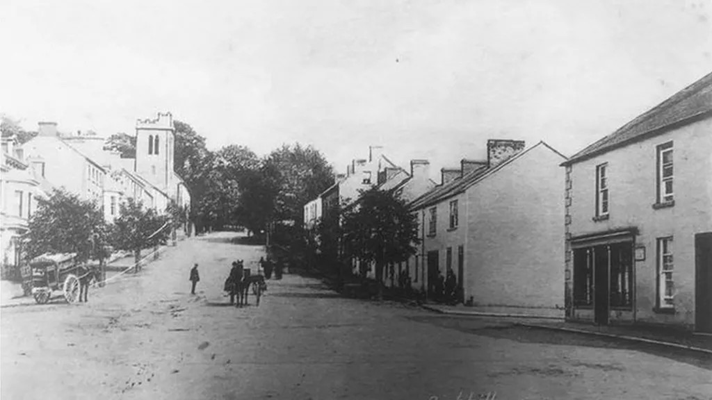
Richhill County Armagh
With the prosecution’s case concluded, Mr. Wilson commenced the defence. He first called Susan Troughton, who testified that Sarah Pearson had informed her of witnessing a ghost a few weeks prior to Mrs. Pearson’s demise. Subsequently, Jane Glover, an older sister of the defendant, was summoned and questioned regarding her sister’s mental health.
“She suffered from hysteria before she was married and while she suffered from it she was outrageous.”
“What type of girl was she?”
“She was always of a soft nature and easily led.”
“How long was she married?”
“She was married eleven years.”
“When did she go to Canada?”
“She went to Canada on the 12th of August, a fortnight after her husband was sent to jail.”
“Is there a history of insanity in your family?”
“An aunt of my mother had been in an asylum in Yorkshire, and my grandfather had been similarly affected.”
Mr. Wilson proceeded to call a witness to testify about the nature of the relationship between Sarah and Isaac Pearson, at which point the Solicitor General raised an objection.
Mr Justice Wright. “I cannot admit this evidence. The prisoner and her husband appear to have been a very ill-assorted couple and to have led a very unhappy life. But what has that to do with the present case?”
Mr Wilson. “The question is what influence had he over her?”
“Is that a defence?”
“It is an element that should be taken into consideration.”
“I uphold the objection.”
With no further witnesses left to call, Mr Wilson addressed the jury.
“Does the prisoner’s conduct not prove that her intelligence is below average? Previous to her marriage you have it that she suffered from hysteria, and she has had by no means a happy married life. In the house of the deceased woman the prisoner was free from her husband to a great extent and was comparatively happy there. She and Alice Pearson apparently lived well and comfortably together, and she had nothing to gain by the death of the old woman. So long as Alice Pearson lived she always had a comfortable home, and there was every reason from the viewpoint of an intelligent person, why she would desire the prolongation of the life of the deceased.
I do not suggest that the accused is unfit to plead at this stage, however, the question for you is as to whether on the 27th of June 1904 she was a person who understood the nature and the quality of the act which she is alleged to have committed, and which she has confessed to have committed on that particular day, or whether she is a person of weak intellect, not capable of understanding the morality of her actions. Under the influence of her husband and goaded and threatened by him, she may do an act the nature of which she could not understand. In conclusion I appeal to you to consider those circumstances before you reach a verdict.”
Mr Campbell KC. “Firstly I would like to compliment Mr Wilson on the way he has defended the prisoner. If I myself was in peril of my liberty or property there was no one whose services I would more readily avail myself of than those of my able and elegant colleague. However, Mr Wilson has been making bricks without straw. He has no defence. The evidence shows that the crime was so far from one committed under impulse, excitement or threat, was one of premeditation, prearrangement, and deliberation calm and cool. I direct your attention to the conduct of the prisoner from the day of Mrs Pearson’s death to her flight to Canada. Justice is lame of foot, but it seldom fails to overtake the guilty person who flees from it. The case has been proved beyond the shadow of a doubt, and it is for you to act honestly and fearlessly according to the facts and along the line and path that the evidence takes you.”
Mr Justice Wright then reviewed the evidence for the jury before issuing his charge to them..
“The case in its history and development has assumed a rather peculiar aspect. The evidence for the defence does not strike me as very material to the question we are trying. I think Mr Wilson does not seriously contend that the prisoner did not commit the act. In a kind of way he has suggested she is a weak-minded woman and because of this she acted under the influence of her husband. But everyone is responsible for his or her acts unless they are proven to be insane, and can you say that the prisoner, having regard to her whole conduct and her statements to the police, is a person unaccountable for her actions? Beyond all do you doubt the dinner for the poor old woman on that day was not prepared or given to her by the prisoner, and a short time later the poor old creature died in writhing agony. If you come to the conclusion that death was caused by poisoning and that this poison was administered by the prisoner, then the prisoner, in law, is responsible on the present charge, unless, as I have pointed out, she can be excused by reason of insanity or something of that kind.”
The jury then retired to deliberate on their verdict. During this time, Sarah Pearson remained in the dock. She became visibly emotional on several occasions and requested to be removed from public view. This request was granted, and she was subsequently moved to a waiting room. After a half an hour the jury returned, and the prisoner was brought back into the court. The foreman of the jury announced a guilty verdict and requested Mr Justice Wright to take into merciful consideration the evidence given in regard to insanity in the prisoner’s family.
Mr Wilson. “My Lord, there is a matter which has been pressing upon me, and will you allow me to mention it; that is the evidence as to the prisoner leaving the country on the 12th of August. The suggestion is that she was fleeing her guilt.”
Mr Justice Wright. “That has not been pressed at all, Mr Wilson.”
“I think the evidence was that she left the country…”
Mr Campbell KC. “With great respect I did not suggest anything of the kind.”
Mr Justice Wright. “Oh no; it was not pressed by the Crown at all.”
“We, in fact, closed our case without actually proving the date on which she left.”
“It was not pressed at all, and, I may say Mr Wilson, it is not right to intervene at this stage. I won’t have any discussion about the matter.”
The Clerk of the Crown then addressed Sarah Pearson and asked if she had anything to say why sentence should not be passed. She responded no in a barely audible voice. Mr Justice Wright then proceeded to pass sentence.
“You have found the only verdict which could be found on the evidence, which was unmistakeable, cogent and conclusive, and removed all doubt as to the fact that the deceased woman met her death through poison. The crime was a particularly cold and callous one, callously carried out for a mean and sordid motive, which, beyond all doubt was to cut short the life of the deceased for the sake of a few paltry pounds. I do not desire to dwell on the enormity of the crime or to dilate upon the terrible position in which the prisoner has found herself in consequence of the verdict that has been arrived on. And I do not wish to hold out to her, so far as I am concerned, any hope of mercy in this world. You have unanimously found her guilty and have recommended her to mercy on the grounds that there was insanity prevalent in some members of her family. That recommendation will be at once forwarded by me to the proper quarter, but I have no power to give effect to it. It would not be an act of kindness on my part; indeed, it would not be proper of me to hold out any hope of mercy.”
Mr Justice Wright then placed the black cap on his head and passed the sentence of death on Sarah Pearson, directing that the execution take place on the 30th of March. The prisoner was then led from the dock in a near state of collapse.
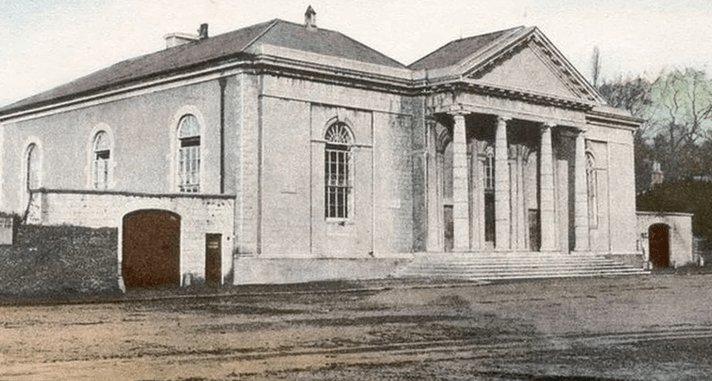
Armagh County Courthouse
The following morning, Friday the 10th of March, Agnes Black appeared in the dock holding her three-week-old baby. The Solicitor General, Mr J.H. Campbell KC prosecuted while Mr Justice Wright once again presided. The prisoner was defended by Mr R. Best. When the case was called the Solicitor General stood and addressed the court.
“I would like to say in regard to the indictment on the capital charge, I have considered the matter most carefully with my colleagues. Of course it is a very responsible matter for us in regard to the duty I have to discharge to the public. However, having given the case the most careful and anxious consideration, I have come to the conclusion that apart from all the suspicion there might be, I cannot see that the depositions disclosed a case upon which the jury can reasonably come to the conclusion that Agnes Black took an actual part or hand in the administration of the strychnine.”
Mr Justice Wright. “You mean in the poisoning that caused death?”
“Yes. It is now clear that the immediate cause of death was the administration of strychnine, and in the absence of more direct evidence connecting her with that charge, I have come to the conclusion not to proceed with the capital indictment against her, but to take up the other.”
“What is the other indictment?”
The Clerk of the Crown. “That is the charge of administering metallic mercury with intent to feloniously kill and murder, and there is a second count that she did cause to be administered to Alice Pearson a quantity of metallic mercury with intent to kill and murder, and there are two other counts.”
Mr Justice Wright. “That is a bill found against her alone. I am sure the Crown has taken the proper course.”
Agnes Black was then arraigned and pleaded not guilty. After a jury was sworn the Solicitor General opened the case.
“All of yesterday here was occupied, before His Lordship and a jury of your county men, in investigating a charge of murder against Sarah Anne Pearson for the murder of an old woman named Alice Pearson on the 27th of June last. In that charge, the prisoner in the dock, Agnes Black was included. However, inasmuch as some of the matters that would have been brought out in the evidence of the case would have only applied to one of the prisoners, while other matters would have applied to the other, I thought it my duty in fairness to both, that they should not be tried together, so no evidence should be given against one which was only relevant to the case of the other. After a full consideration of the facts disclosed at yesterday’s proceedings, I’ve come, after considerable hesitation and misgivings, to the conclusion that I am not warranted to proceed with the capital charge against Mrs Black. Accordingly she is now free of that charge, however, there still remains a very serious charge; that is of administering an injurious or poisoning substance to the old woman in the attempt to take her life. It will be a relief to you, as it is to me, to know that we are not trying the prisoner on the capital charge. The charge you have to deal with, although a serious one, is of course, nothing like so serious or grave in its consequences as the capital charge.
I will now relate to you as briefly as I can the facts of the case. On the 5th of October 1903, while living with her mother, Alice Pearson, the prisoner completed an insurance for £8 and fourteen shillings on the life of her mother. For my own part I would gladly welcome a change in the law that would prevent insurances on the lives of young children or aged persons. I cannot conceive a greater temptation to people in humble circumstances. Human nature is weak and frail and subject to temptations of all kinds, and perhaps in the weakness of their nature the strongest temptation of all is the temptation of gold or money. Practically from the 5th of October Alice Pearson became the victim of a strange and mysterious illness, which used to attack her and to which the prisoner even referred to as a cutting of the bowels. All that time the Crown say she was being dosed with quicksilver by the prisoner. There was a terrible deliberation and devilish malignity to the operation the prisoner adopted, because the nature of quicksilver has this peculiarity; it requires large and repeated applications of the stuff to cause death. There was also a peculiarity about the insurance policy that if the mother died within a year the prisoner would only get half the policy, and I suggest that the evidence will satisfy you that the prisoner exposed her mother to a lingering a tedious death, calculating a year of applying the metallic mercury would keep her alive that long but no longer.
However, it was not only the policy, which was a temptation for this crime, because the old woman had close to £100 in the savings bank. In November 1903 the deceased made a will by which her property was evenly divided between her son and daughter. In November 1904 the Blacks cleared out of her house and they left Sarah Pearson, who was convicted yesterday. Subsequently the old woman made a second will leaving everything to her son except for £5 to the prisoner. Strange to say that the first will was proved and the prisoner got half.”
The Solicitor General proceeded to discuss the relationship between Agnes Black and Sarah Pearson. He then addressed the acquisition of quicksilver, which Black stated was required to repair her husband’s shaving mirror and concluded with the details concerning the death of Alice Pearson.
“I do not charge that Agnes Black was directly involved in the application of the strychnine. If I thought she was I would have proceeded against her on the capital charge. My own inference based on the facts is that the administration of the strychnine was done by Sarah Pearson without the prisoner’s knowledge. I believe she would have preferred to wait for the quicksilver to do its job so she would be eligible for the full amount of the insurance policy. But one thing is certain, that within twenty minutes before the old woman expired in agony from the strychnine, she was given an enormous dose of quicksilver. Who gave her that or caused it to be given? Sarah Pearson bought nothing but strychnine. Who was working in the quicksilver line? Why did the prisoner buy it? When six months afterwards the body was taken from the grave there was found, just as fresh as when it left the druggists shop, nearly 300 grains of mercury. When the old woman was in that writhing agony on the morning of her death the prisoner was sent for. She came and was in the house half an hour before her mother’s death. Whether it was that the devil again entered into her mind and suggested that now would be the time to administer another dose of this awful stuff that she had been dosing her with for months, undoubtably either she or someone else, by her direction, administered there and then to the old woman a tremendous dose of mercury. From the day of the death to the burial the prisoner never touched her mother’s body. She took no part in the laying out nor did she attend the funeral. The worst criminal who ever lived shrank from touching the corpse of his victim once his objective had been completed. Before the body was exhumed on the 7th of November the prisoner prophesised that it would be and said she was sure it would be found out that the old woman had been poisoned. What you as the jury have to determine is whether the prisoner either by her own hand or anyone else’s hand was responsible for the presence of mercury in such a large quantity in the old woman’s body.”
The first witness called by the Crown was Mr George Kennedy, an agent for the Pearl Life Assurance Company. In September of 1903 he stated that he issued a policy to Agnes Black on the life of her mother. The Solicitor General read out the terms of the proposal on which the age of the deceased was stated as sixty-five. It would be proved that she was actually seventy-four at the time. The sum insured was for £8 and fourteen shillings, and the weekly premium was sixpence. In reply to the question was the insured person in good health the answer was yes, and as to whether she was inflicted with any disease or infirmity the answer was no.
Mr Campbell KC. “How much was paid to Agnes Black following the death of her mother?”
Mr Kennedy. “The amount of £4 and 7 shilling was paid to Mrs Black following the death of her mother, as her death had occurred within twelve months of the policy being taken out.”
“Did you see Mrs Pearson after the prisoner took out the policy on her life?”
“I did.”
“And did you inform her of that fact?”
“I did not.”
“Why not?”
“Mrs Black requested me not to.”
Mr Best. “Is it not usual to inform the person whose life the policy has been take out on about the policy?”
“It is not at all usual to let the person know.”
“Did Mrs Black ever talk to you about stopping the premiums?”
“Yes, once.”
Mr Campbell KC. “Do I understand that it is a usual thing in this country for insurance agents to insure a mother’s life at the request of a daughter when she doesn’t want the mother to know?”
“She can insure her daughter.”
“Oh! Attend to your oath sir! Do you say it is a usual thing?”
“It was usual with me.”
“I hope you have dropped it! Are you out of this business now?”
“Oh, yes.”
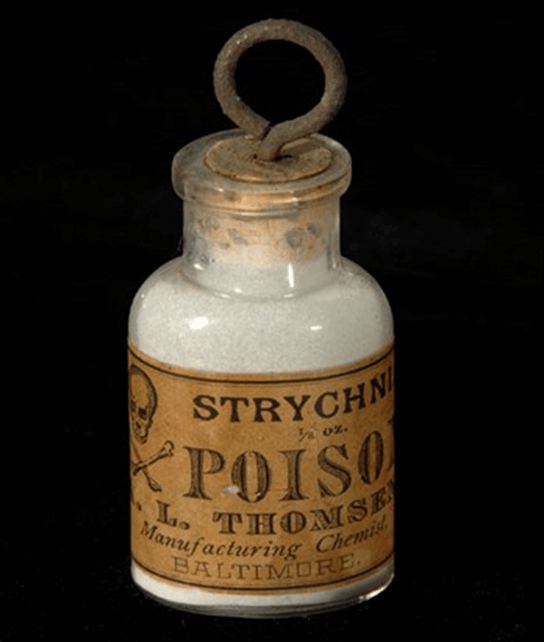
The Fatal Substance
The next witness, John Troughton, gave evidence similar to his testimony at Sarah Pearson’s trial the previous day before being cross-examined by Mr. Best.
“At the time Agnes Black came to live with her mother no will had been made?”
“That is correct nor had any insurance policy been effected.”
“Was there much quarrelling between the mother and daughter?”
“No; apart from some little tiffs now and then.”
“After Agnes Black’s husband got a new job and they moved elsewhere did Isaac Pearson employ someone to look after his mother?”
“He got a young girl in.”
“Was there any quarrels between the defendant and Sarah Pearson?”
“There was when Agnes threatened to take wages off her mother.”
“Was the fact that the defendant had an insurance policy on her mother’s life a secret?”
“No; it was not.”
“And was it a secret about her mother having the cutting of the bowels?”
“No.”
“Now a great point has been made by the Solicitor General about this inhuman woman not going to her mother’s funeral. Just tell us, is it usual for any woman to go to funerals in this part of the country?”
“It is not. I have seen very few.”
“And isn’t it usual for neighbours to perform the office of preparing the body for internment?”
“I believe it is.”
The Solicitor General then proceeded to call other witnesses who had given evidence the previous day. Annie Troughton stated that it was Agnes Black who asked her to bring in some neighbours as Mrs Pearson was dying and that Agnes was standing beside the deceased’s bedside when she came back to the house on the second occasion. Susan Troughton was asked was Alice Pearson a troublesome woman.
“Agnes Black told me that she was. On one occasion she said she was going to Portadown to see about quicksilver and that only for she was afraid of her mother’s ghost she would give her a pill.”
Mr Best. “Did you ever hear Sarah Pearson make threats against the deceased?”
“Yes and I heard her call her an old rascal.”
James Troughton then repeated his statement about purchasing the quicksilver and also mentioned an occurrence on the day of the old woman’s funeral.
“On the evening of the day of the funeral Agnes Black came to my house and asked me to accompany her to her mother’s house, as she was afraid to go in alone. She said Isaac, her brother, had told her that Sarah Anne had poisoned her mother; that the poison was mixed in her dinner of potatoes and eggs. She said the old woman had got something in the morning, but it didn’t affect her. About a week after the funeral she told me that Sarah Anne wanted her to come up and give the old woman the dinner she had prepared for her. She did not do so, but she said if she had her little boy would have been poisoned too.”
Mr Best. “On the day of the death did Sarah Pearson tell you she had prepared and given the dinner to the old woman?”
“She did.”
“Did you ever hear Sarah Pearson threaten the deceased?”
“Yes; she said she would knock her brains out with a chair if she did not hold her tongue; that hell would not be full until she was in it.”
The next witness, Anne Reid, recalled when Agnes Black came to live with her mother.
“Alice Pearson used to come to my house but after Agnes appeared on the scene she stopped.”
Mr Campbell KC. “Did you ever hear the prisoner mention quicksilver?”
“Yes; in early June she came to my house and said she was going into Richhill for quicksilver in order to mend a looking glass.”
“Did you speak to her after her mother’s death?”
“Yes; on the 28th of June I met her on the street, and she told me that the police had been out to tell her that there would be no inquest into her mother’s death. I said to her I thought there should be and she remarked that she did not desire one in case she was blamed.”
Public analyst Robert Barklie repeated his evidence of the previous day about finding strychnine and mercury in the organs of Mrs Pearson. He went into more detail with regard to the mercury.
“In her stomach I found 286 grains of mercury, it must have got into her body very shortly before her death. My reason for this conclusion is that there was no trace of mercury found immediately near or in any portion of the alimentary canal.”
Mr Campbell KC. “What would be the effect of taking quicksilver regularly?”
“Taken constantly, quicksilver would produce violent purging and might bring on inflammation which would hasten death.”
Mr Best. “What was the cause of death?”
“Strychnine was the immediate cause of death.”
Mr Campbell KC. “When do you believe the last dose of quicksilver was given to the deceased?”
“I believe the mercury must have been given to her between the dinner and her death, assuming the dinner was given to her an hour before her death.”
The next witness was R.I.C. Head Constable Doyle who arrested Agnes Black in Wallsend, England on the 15th of December 1904.
Mr Campbell KC. “Did the prisoner make any statements to you following her arrest?”
“She made certain statements to me. She asked me how long did Isaac Pearson get at the Assizes and I told her he had got fifteen months to which she replied, and I quote. He didn’t get half enough, he’s a bad ‘un, Sarah Anne is a bad ‘un. Where did she get the strychnine? Further on in the journey she kept talking a great deal about Isaac Pearson and Sarah Anne Pearson until she fell asleep. Several times she claimed that she was as innocent as I was. She also said, and I quote. I left my mother as well as ever on Saturday before she died. Sarah Anne came down on the Sunday evening and asked me to go up the next day and give my mother her dinner; that she had to go and see her daughter. My husband told me that I had to mend his old trousers, and that I could not go as he was going to tar, but Greer’s boy put on the tar and I never mended the trousers. Yet she must have got something in the dinner. When I got the word to go up I thought that she was only lonely when Sarah Anne was away. She did not live above an hour after I went up. She was in convulsions when I went up and I had to wipe the sweat off her face, and there was little bubbles on her lips. At another stage she told me that the Troughton’s know that she is innocent.”
The Solicitor General then told the court that it was only fair to the prisoner for him to read a statement from a Dr Tate which in essence said that he had visited Alice Pearson the previous January and had said there was nothing he could do for her. The Crown then rested.
The defence only called two witnesses, the first, Ann Jane Bertram, told the court that Sarah Pearson had told her that Mrs Pearson had complained of a bad taste off a drink she had given her and the other witness, Jane Troughton, stated that Sarah Pearson had come for her on the day Mrs Pearson died, and that on the two occasions she went to the house that day she did not see Agnes Black there. Mr Best then addressed the jury.
“The transactions relating to this terrible case are known almost all over the world. Both the defendant and Sarah Pearson had been returned for trial on the capital charge, and I am glad owing to the course taken by the Solicitor General, that it is not necessary for me to ask you to stand between this woman and the scaffold. Even so, this case is a grave one. There are four counts on the indictment, and each are a simple variation of the first. It is a charge that Agnes Black caused to be administered to her own mother a quantity of metallic mercury, with the intent to murder her. The Crown, I must say, has not unduly pressed the case. The Crown do not seek victims; it does not seek to convict persons who are not guilty, and I for one, on the other hand, do not want to get anyone acquitted if you, the jury, are satisfied that such a person has committed a crime.
The motive suggested by the Crown cannot be sustained. Agnes Black did not seek to affect the assurance and only did so after repeatedly being urged to do so. Even when the insurance was effected she did not seem desirous to continue it, in fact the evidence of the insurance agent states that she talked about discontinuing it. This is the motive for the crime set forward by the Crown, and I ask you to hold that it is not sustained by the evidence. In the same way it cannot be contended that the amount by which Agnes Black would benefit, namely £5, under the second will can be accepted as motive. You know the ways of this county in these matters and know that when a will is made its contents are pretty well known to the friends and family, and so it is pretty safe to assume that Agnes Black knew the only benefit she would get from her mother’s death was £5.
There is not a particle of evidence from the Saturday previous until the day of her mother’s death that she was near her mother’s house. Can you believe it is the attitude of people who contemplate a crime that they go around the country blabbing that they were buying mercury for such a purpose? Had Sarah Pearson, for example, told anyone that she had bought strychnine? Can you entertain on the other hand the belief that it was a deep laid and crafty scheme to go around and talk about the purchase of mercury in a public way to allay suspicion? It is not sufficient for the charge even if the Crown proved that Agnes Black got mercury and gave it to Sarah Pearson and knew afterwards that Sarah Pearson had given it to her mother, because the charge here is that she either administrated or caused to be administrated this mercury with intent to murder. Guilty knowledge is not enough to sustain the charge made by the Crown.”
At this stage Agne’s Black’s infant awoke and began to cry loudly leaving Mr Best unable to proceed. A wardress in the dock took the baby off the prisoner and brought it into a waiting room, leaving the prisoner sobbing. Mr Best then continued.
“I ask you, the jury, to ask yourselves what opportunity had the prisoner to administer a dose of mercury on the day of the old woman’s death. The evidence is that she only reached the house when her mother was in her death agonies, and she got into the bed to hold her mother. Can you accept the desperate suggestion that almost while dying the old woman was gasping out. Bye, bye Aggie, God have mercy on me, she seized the opportunity to give her mother this dose of mercury? Was it not more likely that the hand that gave the old woman a drink of water, Sarah Pearson, was also the hand that administered the mercury? If you are satisfied beyond all doubt that the prisoner is guilty of the crime charged, then I do not ask for any acquittal at your hands; but if you are not so satisfied, I ask with every confidence for an acquittal of the woman in the dock.”
After the Solicitor General replied, Mr Justice Wright charged the jury.
“The crime that was committed on the 27th of June 1904 was of a most appalling character and has stained the fair fame of County Armagh. The charge against the prisoner is not as grave as the one of which Mrs Sarah Pearson was found guilty of; but though a lesser charge of having administered to her mother a poison with the intent to take away her life, it is almost of equal gravity and the case if proved involved almost equal criminality. It is almost impossible for a judge to be engaged in two more awful days’ work than I have. The crime was horrible, unnatural and revolting. Such crimes have been committed before, but they are rare. The prisoner, judging from the evidence heard, strikes me as having somewhat of a callous nature, and had not the feelings towards the old woman that a daughter ought to; otherwise it is hard to explain the statements that she made. You have it that she told a neighbour she would give her mother a pill only for she was afraid of her mother’s ghost. During that last half hour of the wretched woman’s life, as she was expiring in agony, it does not appear that anyone was with her except her own daughter. What occurred during that half hour? It was proved that from the hour the prisoner came to live with her mother, the latter suffered from this cutting of the bowels. The purchase of mercury by or for the prisoner was proved, and it was proved by the analysis that mercury was found in the dead woman’s stomach. What do all these things mean? Taking all the facts it is for you to say whether the charge brought by the Crown has been proved. Are you or are you not satisfied that the Crown has beyond all reasonable doubt proven their case. If you think they have not, or if you have any reasonable doubt, then you are bound to acquit the prisoner; but if there is no such doubt, then you must vindicate the law.”
The jury returned after a half an hour with a unanimous guilty verdict and Mr Justice Wright said that he would defer sentence until the following morning.
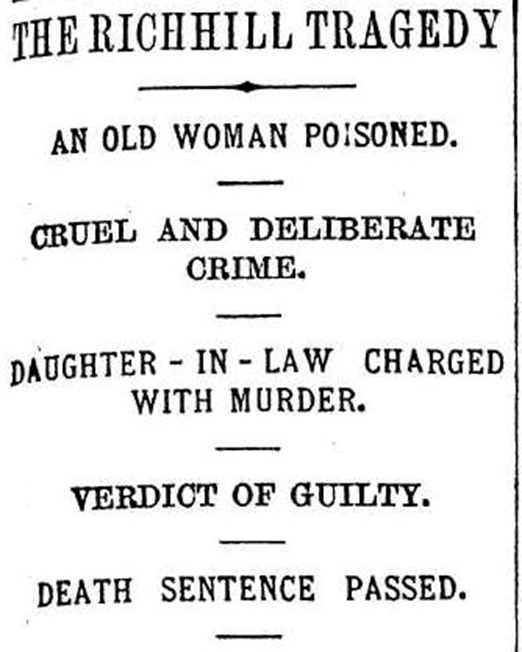
Belfast Newsletter 10th of March 1905
When the court assembled the next day Mr Justice Wright addressed Agnes Black, who was feeding her baby in the dock.
“You have been convicted of administrating metallic mercury to your own mother. The verdict is absolutely right. The evidence was conclusive and irresistibly led to that conclusion, from which there is no escape, notwithstanding the very able defence of Mr Best. The Crown elected not to try you on the capital charge upon which Sarah Anne Pearson was tried, found guilty and sentenced to death. I will not conceal from the jury, nor will I conceal from the public the conviction I have in my own mind that you are not one whit less guilty than Sarah Anne Pearson. It is absolutely certain you had in your mind the death of your mother, that you intended to cause her death by the slow release of metallic mercury. You had been administrating this quicksilver, as it is called, for months, the effect of which you knew was to cause great weakness and to sap the little strength left in the woman’s body. The motive of the crime was obviously money, not only the amount you had insured her life, for but for whatever money she had in her savings account. You are just as guilty as Sarah Anne Pearson. I have a duty to perform for society. The prisoner’s crime is a terrible and unnatural one and the punishment I am about to pronounce is also terrible, namely, penal servitude for life; for the remainder of your natural life.”
Agnes Black appeared stunned at the verdict and staggered down the stone steps to the waiting room where she broke down uncontrollably before she was taken away in a prison van. After she had been taken down the Solicitor General rose and addressed Mr Justice Wright.
“A reference was made to the fact that there was no inquest following Mrs Pearson’s death. It is only right to say that the police reported the facts of the case to the proper quarter, but the coroner, in discharge of what he considered to be his duty, did not think an inquest was necessary.”
Mr Justice Wright. “Now we know different.”
A few days before her planned execution, Sarah Pearson’s death sentence was commuted to penal servitude for life. Shortly afterwards the two women were removed to Mountjoy Prison in Dublin. Isaac Pearson, who had previously been sentenced to fifteen months in jail for rape, was convicted of the same crime again in 1907. On this occasion, he received a sentence of two years imprisonment with hard labour.
From My Book Lady Killers

 Pat Doran Author
Leave a comment