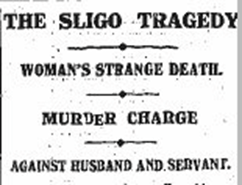
Early on the morning of Tuesday the 8th of December 1914, Rosa di Lucia was found dead on the floor of her bedroom above the ice-cream parlour, Macari and Co., which was operated by her husband Angelo on Radcliffe Street, Sligo. Rosa had sustained significant head injuries, and upon investigation, the police determined that her death was not due to natural causes. The coroner for the district, Dr. P.M. Quinn, commenced an inquest the following afternoon at the premises of Macari and Co.. R.I.C. Head Constable Davis from Tubbercurry led the proceedings on behalf of the Crown, assisted by Sergeant Kearins. R.I.C. County Inspector Sullivan was also present to observe. An eighteen-man jury was sworn in prior to the testimony of the first witness, the husband of the deceased, Angelo di Lucia. He identified the body found upstairs as that of his wife of ten years, Rosa di Lucia, who was thirty years old.
Head Constable Davis. “Did you go upstairs on Monday night?”
“Yes; I went up at about half past ten and then at about midnight to go to bed.”
“Did you go to bed in your wife’s bedroom?”
“No; she had a baby about a week ago and I haven’t slept in there since.”
“Did you go into her bedroom on Monday night?”
“I did. I sat in the room with her for about five minutes and then I went to bed with my brother, Pasquali.”
“When you left your wife was she in bed?”
“Yes; she was.”
“Was anyone else present?”
“The servant girl and two children were in the room. I told the servant girl to stay with my wife that night, but I don’t know whether she slept with her.”
“Where was the servant girl when you left the room?”
“She was sitting by the fire reading a newspaper.”
“You then went to bed?”
“Yes.”
“Where did you undress?”
“I took off my clothes before going into the bedroom.”
“Did you wear a nightshirt?”
“No; a shirt and undershirt.”
“What time did you wake up on Tuesday morning?”
“I was awakened close to seven o’clock by the shouts of the servant girl calling me. I pulled on my trousers and on-going out found the servant girl on the stairs and she said to me. Your Missus is lying on the floor. I then went into my wife’s bedroom and found her lying on the floor.”
“Where exactly on the floor was she lying?”
“Her head was near the stove, and her feet was near the bed.”
“Was she alive?”
“She was breathing heavily and was not then dead. She snored when I lifted her head and opened and closed her eyes and then died.”
“Was the room dark?”
“The gas was lighted a little and I could see her face. I saw her head broken and a hammer nearby…”
Sergeant Kerins then produced a hammer and Head Constable Davis asked was it the hammer that was lying at the left hand side of the body.
“Yes it is.”
“Was your wife left-handed?”
“No.”
“What did you do next?”
“When I saw my wife’s condition I sent the servant girl for water, which she brought.”
“Why did you send her for water?”
“To wash my wife’s face, she had three wounds on her forehead.”
“What is the name of the servant girl?”
“Jane Reynolds.”
“Was there much blood?”
“There was a pool of blood about six inches square on the floor under her head.”
“Besides washing your wife’s face did you do anything else?”
“I took off her nightdress and burned it in the stove.”
“You got no blood on your own clothes?”
“No; but my hands were bloodstained after washing her face.”
“After you burned her nightdress what did you do?”
“I put a clean nightdress on her and a cloth around her head. The cloth covered her forehead down to her eyebrows.”
“Was it after you put the body back on the bed you did this?”
“Yes.”
“Then what did you do?”
“I sent the servant girl and my brother to get the priest.”
“Was anything done before the priest arrived?”
“Yes; I sent the servant girl for a mop and bucket to wash the blood off the floor. I could no longer look at it.”
“Was there any blood on the hammer?”
“I didn’t see any.”
“What do you believe happened to your wife?”
“I believe she did it to herself?”
“And why do you think that?”
“In consequence of a conversation we had a few days previous. She said to me that she thought I was discounting her on accord of having three daughters and no son. I told her I did not mind and she then said that she would leave me sometime.”
“Did you ask the servant girl what had happened?”
“No; I did not.”
“Did you ask her had she stayed in the room all night?”
“No.”
“Have you spoken to her since?”
“No; I haven’t.”
“Did she tell you your wife had killed herself or did she make any statement about your wife at all?”
“No; she did not.”
Dr Quinn. “Were your wife and the servant girl on friendly terms?”
“Yes; they were. In fact, my wife had promised to buy her something once she was up and about.”
“Why did you send both the servant girl and your brother for the priest?”
“One was afraid to stay in the house without the other, so I sent them both.”
The next witness called was Canon E. Doorly, who testified that on the morning in question he was called upon by Pasquali di Lucia.
“I had some difficulty at first in understanding what he was saying but soon I realised I was wanted in his brother Angelo’s house. I arrived at the house at about ten past eight and went upstairs. I went into the room of the deceased, and I saw her lying on the bed with a bandage around her head.”
Head Constable Davis. “Did you see the husband of the deceased?”
“Yes; he was in the room and seemed to be greatly upset.”
“Did you see the servant girl?”
“Yes; she was in the room also.”
“What did you do?”
“I asked the husband to leave and after he did I went over and touched the cheek of the deceased to see whether she was hot or cold. She seemed quite warm and I thought she may have been in a semi-conscious condition. I proceeded to anoint her.”
“Did you remove the bandage around her head to do this?”
“Yes.”
“When it was removed did you notice any wounds on her forehead?”
“I only saw one wound, and I asked the servant girl how she had got it. She said that she had been left to mind her but had fallen asleep and didn’t know what had happened.”
“Did you speak with Mr di Lucia?”
“I saw him after, but he was so overcome with grief I didn’t ask him anything.”
Pasquali di Lucia, the seventeen year old brother-in-law of the deceased was called next and asked what he remembered about Monday night.
“I went up to bed at about a quarter to twelve that night accompanied by my brother Angelo. Both of us slept together and I slept very sound.”
Head Constable Davis. “Did you hear your brother leave the room during the night?”
“No.”
“What time did you wake up at?”
“At about a quarter to seven.”
“And was your brother still in the bed?”
“No. I was awoken previous to that by the servant girl calling my brother. She had come to the door and said to Angelo. Come and see your wife; she is dying, lying on the floor.”
“What did you do?”
“I went back to sleep again. Then the servant girl came back into the room with one of the children and told me that my sister-in-law was dead. I then got up and went into the room where I saw Rosa lying on the bed with a bandage on her head.”
“Was your brother in the room?”
“Yes.”
“Did you speak to him?”
“No; he was crying.”
“What did you do next?”
“My brother sent me to get the priest and the servant girl to get a neighbour.”
“Are you certain it was a quarter to seven when you awoke?”
“Yes; I am certain because I looked at my watch.”
“When you returned was there any talk of what had happened?”
“I heard the servant girl say to the nurse. The Missus took four bottles of lemonade; she came down to the shop for it. I then told the Missus to go asleep, but the Missus took some notion and came down the stairs again and brought up another bottle of lemonade which she offered me to take but I refused, and then I fell asleep on the chair. I next heard the children crying and I lit the gas. When I did so I saw the Missus lying on the bed with her head on the pillow and her legs on the floor.”
“Was there anyone with you when you went for the priest?”
“No.”
“Did not your brother send the servant girl with you for the priest?”
“No; he did not.”
“Where was she when he sent you for the priest?”
“She was in the room with two of the children.”
“Did the servant girl say anything to you?”
“She said to me. The Missus might have killed herself with the hammer.”
“When did she tell you this?”
“While the nurse was still there.”
Dr P.J. Flanagan was the next deposed.
“I was attending the deceased after her confinement, which I think was Tuesday last. Her confinement, as far as I could see, was perfectly normal. The deceased insisted on getting out of bed when she had no right to, and I was half afraid there was something wrong with her mind. I saw her on Sunday night and she was apparently getting on well, and on the road to recovery. The next time I saw her was today. I held a post mortem examination with the assistance of Dr Rouse. I found one long wound, one inch long, in the centre of the forehead. This wound extended to the bone. There was also one contused wound on the left side of the forehead somewhat circular in shape and intruding to the bone. It was about the size of a shilling. There was another contused wound on the centre of the nose with slight scratches on the right side of the nose and cheek. There were traces of blood on the scalp and hair and about the fingernails and right shoulder. The face and hands and a portion of the body showed signs of being washed. A contusion at the right side of the top of the head was the size of a penny. On lifting the scalp, a corresponding contusion extended to the bone. The depressed fracture of the skull corresponded with the curved wound on the forehead. The brain was congested on the surface but otherwise it was healthy. The lungs, heart, kidneys, stomach and liver were healthy. There was a small quantity of milky fluid in the stomach. There was an abrasion on the knee which might have been caused by a fall. There was a small bloodstain on the chemise about the neck, otherwise the garment was clean. Death in my opinion, was caused by shock following concussion of the brain, produced by blows to the head.”
Dr Quinn. “Was death immediate?”
“No; it was not.”
“Could the wounds have been self-inflicted?”
“No; they could not have been.”
“What do you believe caused the wounds?”
“The curved wound corresponded with the circumference of the head of a hammer in size. All the wounds, more or less, corresponded with the head of a hammer and were delivered by some such like weapon.”
“Could the deceased have drunk three or four bottles of lemonade shortly before her death?”
“No; some traces were bound to have remained in the stomach.”
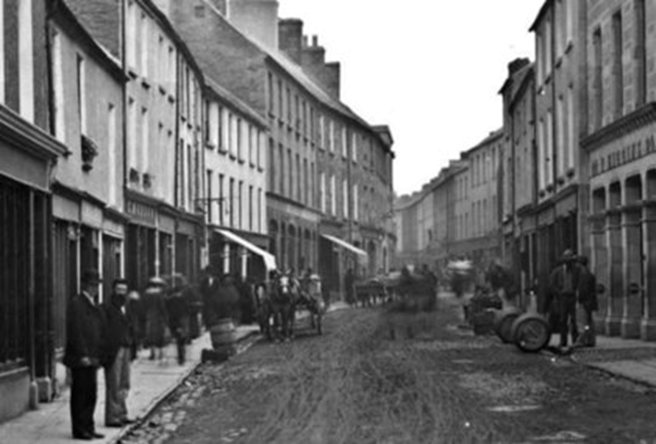
Radcliffe Street, Sligo, on which the di Lucia’s Ice Cream Parlour was located.
The next witness called was the servant girl, Jane Reynolds, who was seventeen years of age. She stated that she was from Ballymote and had been in the employment of the di Lucia’s for the last five months.
“What duties do you carry out for the di Lucia’s?
“My duties are to mind the baby, make the beds and stop in the shop until it closes at night.”
“What is sold in the ice-cream parlour at night?”
“There are fish suppers, minerals, cigarettes and chocolate sold there at night.”
“And what time does the shop close at?”
“At half eleven or half twelve every night.”
“On the day before her death was Mrs di Lucia confined to bed in her room?”
“She was.”
“What time did you retire at on Monday night?”
“I went upstairs that night at about twelve o’clock with the boss to go to bed. I went into the Missus’s room to stop for the night.”
“Was that routine for you to stop with Mrs di Lucia?”
“It wasn’t but one day during the week I went upstairs and found the baby lying on the floor. I told the nurse about it, and she said the Missus had no right to be left alone.”
“At what time did Angelo di Lucia leave his wife’s room that night?”
“He left at about five past twelve.”
“Did everyone go asleep then?”
“No; the Missus fed the baby and dressed her before putting her back in bed again.”
“Did Mrs di Lucia have to get out of the bed to do this?”
“No; she did it while in the bed.”
“And what were you doing?”
“I remained at the fire until two o’clock rocking the other baby.”
“At two o’clock what did you do?”
“At two o’clock I took the cradle down beside the bed and I got on the bed beside the Missus to stretch out.”
“Was Mrs di Lucia asleep?”
“No; she got out of the bed and sat beside the fire for ten minutes before going up to the top room and bringing down some clothes for the baby, which she put on the chair beside the fire. The baby then began to cry, and the Missus went over and rocked her in the cradle. At about three o’clock she went down to the shop where she remained for about fifteen minutes and by the time she came back up I was sitting by the fire.”
“Did she speak to you when she came back?”
“Yes; she sat beside me and put up four of her fingers saying at the same time she had drank four bottles of lemonade. At about four o’clock she went back down to the shop again and brought up another bottle of lemonade, which she poured out into a jug and asked me to drink. This I refused to do and she then threw half of it in my face and pushed me back from the fire. She then told me to go asleep, and I asked her to go to bed as the doctor, who was attending her, would be angry the next time he paid her a visit, but all the Missus said was. Not at all, that and a few other words was all the English she could speak.”
“Did Mrs di Lucia go to bed?”
“No.”
“Did you?”
“I stretched out on the bed facing the door. The Missus then went to the door and fastened it then came as far as the cradle where the baby lay and placed a sheet over the face of the baby. She then came over to me to see if I was asleep and when she saw I was not she grinned at me and I laughed back at her in return. She then went back towards the fire, and I went asleep and I did not wake until the baby started to cry.”
“What time was that?”
“At about six o’clock.”
“What did you do?”
“I got up. The gas was out in the room, and I filled the baby’s bottle in the dark and put it in her mouth. The other baby then started to cry so I took her out of the cradle. When I took her up I looked towards the bed and I saw the Missus lying with her head on the pillow and her feet resting on the floor. Part of the blanket was covering her feet, and I saw blood flowing from underneath the blanket. I started to cry and ran towards the door; at the same time the two babies began to cry as well. I opened the door and ran out onto the lobby crying. I heard Mr di Lucia open his own door and run out. As he ran past me he asked what was wrong, but I couldn’t answer him. While standing on the landing I heard a fall from the Missus’s room.”
“Was this after Angelo di Lucia had gone in?”
“No; it was before.”
“What did you hear next?”
“I heard Mr di Lucia cry out and proceeded to his room and told him there was something wrong with his Missus. He then slipped on his trousers went to his Missus’s room and started to cry.”
“Where were the children during all this?”
“At the time I went to the boy’s room I had the two children with me. I took up the other child when I was going out on the landing as the cradle was near the door. I followed Pasquali di Lucia to the Missus’s room and saw her lying on the floor. I told them to call Mrs Hanney, who lived next door, but she did not come as there was nobody up in the house.”
“Where was Angelo di Lucia at that time?”
“He was kneeling down beside the body of his wife crying. She was lying on the floor with her hand partly under the table.”
“Did you see a hammer?”
“There was a hammer about four feet away from her on the floor.”
“What happened next?”
“The boss told Pasquali to go for the priest and the three of us left the room. He then went upstairs to get water.”
“Did you not go with Pasquali for the priest?”
“No; the boss didn’t tell me to go with him.”
“What did you do? “
“I went downstairs to the kitchen to light the stove. I had the baby in my arm. After I lit the stove I went back upstairs to the Missus’s room and the boss was there on his knees washing his wife.”
“Did you speak to him?”
“No; he was crying.”
“Did he not tell you to bring up hot water?”
“Not at that time.”
“What did you do then?”
“I went downstairs with the other baby and left her in the kitchen.”
“During all this time did you ever wonder what had occurred?”
“No, I did not.”
“At what time did you go for the nurse?”
“I went at about a quarter to ten. She told me to wait for her, and we both came back at around a quarter after ten.”
“What did you say to the nurse had happened?”
“I told her about the Missus lying on the floor and I also told her about the hammer.”
“Did you not tell her the Mrs di Lucia had killed herself?”
“I did not.”
“Did you say it to anyone?”
“I never said how the Missus got injured to anyone.”
“Did you mop the blood up?”
“Yes; before I went for the nurse the boss told me to get a mop and bucket and wash the blood off the floor.”
“Did you see blood anywhere else in the room?”
“I saw a bloody sheet lying on the floor which I took into the bathroom.”
“Did you see any blood on Mrs di Lucia’s chemise?”
“I did not.”
“Was there any blood on you?”
“None at all.”
“When the priest came into the room where was Mrs di Lucia?”
“She was lying on the bed after being washed.”
“Did you think she was alive?”
“I fully believed she was dead, but I never asked the question.”
“Did Angelo di Lucia ask you what had happened?”
“No; but I told him at about twelve o’clock on Tuesday about the actions of his wife on that night and he never said a word to me.”
“Could anybody have come into the room during the night?”
“No; the Missus had fastened the door.”
Dr Quinn. “Are you sure of that?”
“I am.”
“Well; that is a very serious statement, as there was nobody in the room but yourself, and you are making it plain that nobody did the deed but yourself. There was nobody in the house but Mr di Lucia, his brother and yourself, and as the doctor has sworn the injuries could not have been self-inflicted, some of you must have been responsible for them.”
“I can go down on my knee before God and swear that I did not do anything to Mrs di Lucia.”
“But that is a serious statement that you are making.”
“I am telling you nothing but the truth.”
“Is it not an extraordinary thing that neither Mr di Lucia, Mr di Lucia’s brother, or yourself did not even want to know how the deceased died.”
“I don’t know.”
The evidence presented at the inquest was then concluded, and Dr Quinn addressed the jury
“Well, gentlemen, you have heard the evidence, and I don’t think you can do anything but bring in a verdict that the deceased met her death by shock, following concussion of the brain, caused by fracture of the skull as a result by blows of a hammer inflicted by some person or persons other than the deceased.”
The jury accordingly delivered that verdict.
Following the inquest Angelo di Lucia was arrested on the suspicion of murdering his wife and taken into police custody. Jane Reynolds was escorted to Sligo train station to catch a train to Ballymote. While there she spoke with Head Constable Murphy of Sligo, and as a result of this conversation she was arrested and brought to the police station. After a Special Court was convened, presided over by Mr Henry Monson J.P., Head Constable Murphy addressed the court.
“I would like to read out the statement that was made to me by Jane Reynolds at Sligo train station today. On Monday the 7th of December Angelo di Lucia spoke to me in the kitchen. He said to me that his wife’s head was gone and asked would I kill her for him. I said I couldn’t do the like without someone to help me. He said he would help me if I started it. He told me to go get a naggin of whiskey, that would give me great courage and it would make me strong like a devil. I told him I hadn’t the nerve to do it no matter how strong I was. He said I would be strong enough and that he would marry me afterwards. Mrs di Lucia fell asleep at six o’clock in the morning. During the day on Monday Angelo told me to put something in Mrs di Lucia’s mouth. At six o’clock on Tuesday morning I attempted to put a cloth in her mouth but I was unable to because she was too strong, I had the naggin of whiskey drank at the time, I had a hammer in my hand but I didn’t raise it to the woman as she had me by the hair and a hold of the hammer. She pulled the hammer out of my hand and struck herself on the forehead with the corner of it. As soon as she did she fell down and pulled me on top of her. I roared and she roared and Angelo di Lucia ran into the room and said I would never do it. He then ran and caught his wife by the nose and killed her. I was vomiting while he was killing her. In other statements to me the prisoner said she had relations with Angelo di Lucia and claimed that he had promised to marry her.”
While Head Constable Murphy read out the statement Jane Reynolds sobbed uncontrollably and Angelo di Lucia shook his head in disbelief. At the end of proceedings they were both remanded in custody.
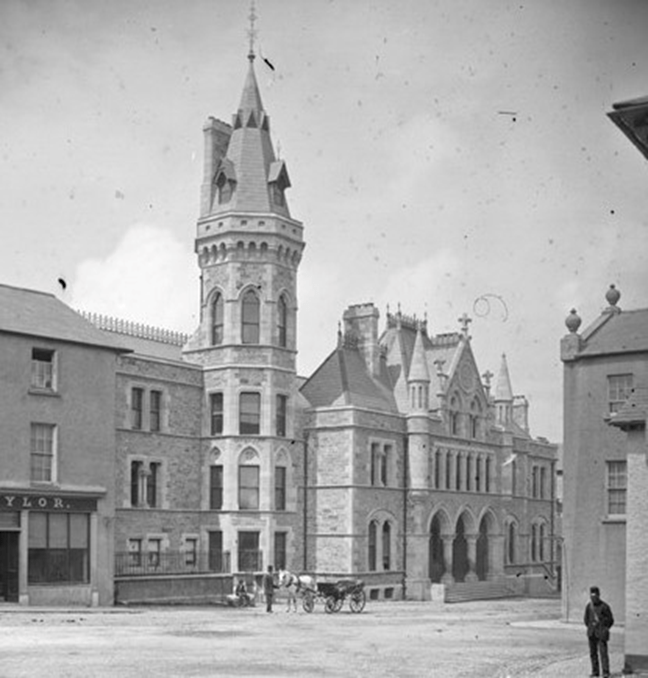
Sligo Courthouse
On the following Tuesday, the 15th of December, the prisoners appeared again in court before Mr. H. Monson J.P. On this occasion, District Inspector Moore represented the Crown, while neither of the prisoners had professional legal representation. The sole witness called was Pasquali di Lucia, who testified that he currently resided at 37 Grosvenor Road, Belfast.
District Inspector Moore. “The man you see here is your brother?”
“Yes.”
“Have you been living with him for near three years in Radcliffe Street, Sligo?”
“Yes.”
“Up to a few days ago?”
“Yes.”
“Is your brother a married man?”
“He is.”
“And what was his wife’s name?”
“Rosa di Lucia.”
“Were they married before they came to Sligo?”
“Yes.”
“Had they three children?”
“Yes.”
“All girls?”
“Yes.”
“The eldest girl is in Italy?”
“Yes.”
“The second child, Mary, when was she born?”
“She was born about eleven months ago.”
“Where?”
“In Sligo.”
“When was the other child born?”
“About a couple of weeks ago.”
“Do you see Jane Reynolds here?”
“Yes.”
“When did she come to your brother’s place?”
“About five months ago.”
“Your brother kept an ice-cream shop?”
“Yes.”
“And was Jane Reynolds employed in the shop as a general servant?”
“Yes.”
“Did she get any nights out during each week?”
“Yes.”
“How many?”
“Three.”
“Did you ever take her out?”
“Yes; three times.”
“Did your brother Angelo ever take her out?”
“He did.”
“How often did he take her out?”
“About three times.”
“Did they go out together alone?”
“Yes.”
“You mean that Mrs di Lucia stopped at home?”
“Yes.”
“Did you and your brother and Jane Reynolds ever go to a dance together?”
“Yes we did; we went to a house of a man named Moran who lived in the Waste Gardens.”
“And I suppose Rosa stopped behind minding the child?”
“Yes.”
“Did your brother take out his wife much at night?”
“No; he did not take her out for a couple of months.”
“Was it during that time he took Jane Reynolds out?”
“Yes.”
“How did your brother and his wife get on?”
“At the time he used to like his wife.”
“How did Jane Reynolds and Mrs di Lucia get on?”
“They got on alright up to a few days ago when she got ill.”
“What got between them when she got ill?”
“They got vexed over the medicine that was to be given after the baby was born.”
“What vexed her?
“Because Jane Reynolds made her take the medicine.”
“You say she had to take two spoonful’s, and she only wanted to take one?”
“Yes.”
“Did you ever see Jane Reynolds give Mrs di Lucia her medicine?”
“Sometimes.”
“Who looked after the child Mary when Mrs di Lucia was sick?”
“Jane Reynolds.”
“Before the infant was born where did Jane Reynolds sleep?”
“In a room at the top of the house.”
“Where did you sleep?”
“In a room on the floor below that.”
“And did your brother and his wife sleep in a room on the same floor as you?”
“Yes.”
“Did your brother ever express any disappointment to you that the third child was a girl?”
“No.”
“Did you ever hear him say anything about it?”
“No.”
“Do you remember Monday the 7th of December, the day before Mrs di Lucia died?”
“Yes.”
“About what time did the shop close that night?”
“Sometime after half eleven.”
“Who was in the house when the shop closed?”
“My Brother Angelo, Jane Reynolds, Rosa, the two children and myself.”
“Did you go into the kitchen after the shop closed?”
“Yes.”
“Who was there?”
“Everyone I have just mentioned except Rosa.”
“Were you the first to leave the kitchen?”
“Yes; I was.”
“Where did you go?”
“I went upstairs to Rosa’s room.”
“How long did you stay there?”
“Just a couple of minutes.”
“And then you went to your own room?”
“Yes.”
“Did you get into bed at once?”
“Yes.”
“And about ten minutes later you heard the others coming up?”
“Yes.”
“Since the day the infant was born did your brother sleep with you?”
“He did.”
“Were you long in the room before your brother came in?”
“He came in at about twelve o’clock.”
“And did he get into bed with you?”
“Yes.”
“Did he tell you about any order he had given to Jane Reynolds as to where she was to sleep?”
“No; but she told me that she was to sleep with Rosa that night to watch her.”
“Did she watch her on Sunday night?”
“Yes; she did.”
“How many nights did she watch her since the infant was born?”
“Two.”
“And was Monday night the third?”
“No; it was the second.”
“How do you know she watched her?”
“She told me.”
“Did your brother ever watch his wife at night?”
“No.”
“Did anyone else ever watch besides Jane Reynolds?”
“No.”
“When your brother was taking off his clothes did he say anything to you?”
“He told me he thought Rosa was going a bit mad in the head.”
“Did you say anything to him when he told you this?”
“Yes; I said God would look after her.”
“Did he say anything about looking after her when she was a bit mad?”
“No.”
“Was there any light in your bedroom when you were going to bed?”
“No.”
“Did your brother leave the bedroom door open?”
“Yes.”
“Is there a gas jet in Mrs di Lucia’s bedroom?”
“There is.”
“Was it lit when you were going to bed?”
“It was.”
“Could you see it from your bedroom door?”
“No.”
“But you could see the shinning of it?”
“Yes.”
“Out on the landing I suppose?”
“Yes.”
“Did you fall asleep?”
“Yes.”
“Had your brother got into bed before you fell asleep?”
“He had.”
“Were you awoken sometime the next morning?”
“I was.”
“What woke you?”
“I heard Rosa shouting three times. Oh! Oh!! Oh!!!”
“You are quite satisfied that it was her voice?”
“Yes.”
“Was there any light shining on the landing at the time?”
“No.”
“Now, was your brother in bed with you at the time?”
“Yes.”
“What was the next noise that you heard?”
“I heard Jane Reynolds crying out. Boss.”
“Could you say where she was when she cried that out?”
“It came from the direction of Rosa’s bedroom.”
“Was your brother Angelo awake then?”
“Yes.”
“Could you say whether he was awake before that?”
“I can’t say.”
“Did he awake at the words. Oh! Oh!! Oh!!!”
“I cannot say.”
“When Jane Reynolds called him what did he do?”
“He got up out of bed and went out of the room in his shirt.”
“Did you remain in bed?”
“Yes.”
“Did he come back to your bedroom?”
“Yes; after about five minutes.”
“What did he do when he came back?”
“He put on some clothes and then left the room again.”
“Did you hear any noise while he was out of the room?”
“No.”
“Did you even hear any talking?”
“No.”
“Now, while he was putting on his clothes did he say anything about what had occurred in the next room?”
“No.”
“In fact, he said nothing at all?”
“No.”
“Did you ask what was wrong with Mrs di Lucia?”
“No.”
“Did you go back to sleep after that?”
“Yes.”
“And who called you?”
“At about seven o’clock in the morning Jane Reynolds called me.”
“Had she anything in her arms?”
“Yes; a child.”
“What child was it?”
“The child Mary.”
“Did she say anything to you when she called you?”
“Yes; she told me Rosa was dead.”
“And she left the room then?”
“Yes.”
“What did you do?”
“I got up out of bed and put some clothes on and then went into Rosa’s room.”
“And where was Mrs di Lucia when you went in?”
“She was in bed.”
“Was she covered with clothes?”
“Yes. The bed clothes were over her and she had a cloth wrapped around her head.”
“And who was in the room?”
“My brother was in the room crying and Jane Reynolds was standing in the doorway.”
“Was the gas lit in the room at the time?”
“Yes.”
“Did you see any blood anywhere?”
“No.”
“Did you see anything on the floor at all?”
“No.”
“Did you see any signs of washing?”
“Yes; between the bed and the stove.”
“What did you do yourself when you went into the room?”
“I got down on my knees and started to cry.”
“Did Jane Reynolds tell you to call anybody?”
“Yes; she told me to go and call a neighbour.”
“That was after you going into the room?”
“Yes.”
“Did you see a hammer in the room?”
“Yes; under the table.”
“Where was the table?”
“Against the wall between the bed and the fire.”
“Was the hammer always kept in that room?”
“Yes it was since Rosa got sick.”
“What was it used for?”
“For breaking coal.”
“Where did you go when Jane Reynolds told you to call some of the neighbours?”
“I went to Mrs Hanney’s.”
“Did you get any reply?”
“No; I knocked at the door twice, but I got no reply.”
“Did you then go back to Mrs di Lucia’s bedroom and tell them that you could not get in?”
“Yes; I did.”
“And the two prisoners were still in Mrs di Lucia’s bedroom?”
“Yes.”
“Now what did your brother Angelo tell you to do?”
“He told me to go and call the priest.”
“And who did you go for?”
“I went for Canon Doorly.”
“After you came back, after getting the priest, where did Jane Reynolds send you?”
“For the doctor.”
“Did you go?”
“Yes; but he was out.”
“You came back to your brother’s house and in to the kitchen, who was there?”
“Jane Reynolds and the child Mary.”
“What did she do or say?”
“She gave me the child and said that she would go and call the nurse.”
“Did she then leave the house?”
“Yes; she did.”
“What nurse did she bring back with her?”
“Nurse Tiernan.”
“Did the nurse go upstairs when she came?”
“Yes.”
“And did Jane Reynolds remain in the kitchen?”
“No; the nurse, myself and Jane Reynolds went upstairs.”
“Did you see the nurse examine Mrs di Lucia?”
“No; I was crying.”
“After going back downstairs did the nurse ask Jane Reynolds anything?”
“Yes; she asked what had happened to Rosa during the night.”
“What did Jane Reynolds say to that?”
“She said that Rosa went downstairs and drank four bottles of lemonade. She then said she went down again and a brought up another bottle of lemonade and she wanted Jane to drink it, but she refused. She said Rosa then threw the lemonade on her clothes.”
“What else did she say?”
“She said she was reading at the fire and Rosa went to bed. She said she went to sleep by the fire and sometime during the night Rosa got up, put on the gas and killed herself with the hammer, and after that the child Mary started crying. She filled a bottle and lit the gas and saw Rosa’s head on the pillow and her feet on the floor.”
“Did she say anything about Angelo?”
“Yes; she then said she called the boss.”
“When did you first see the marks on Mrs di Lucia’s head?”
“I saw them first on coming back from the priests.”
“Who took off the bandage off Mrs di Lucia’s head?”
“I don’t know.”
“Were your brother and Jane Reynolds in the room at the time?”
“They were.”
“I suppose you asked your brother what happened?”
“No.”
“Not a word?”
“No.”
“You were very fond of your sister-in-law?”
“Yes.”
“Did you ever hear your brother say that he wished Rosa had a boy?”
“Yes; I often heard him saying it for fun.”
“Was that before the infant was born?”
“Yes.”
“Was he annoyed at the infant only being a girl?”
“No.”
“That morning after seeing Mrs di Lucia dead did you buy a naggin of whiskey?”
“I did.”
“Who sent you for it?”
“Jane Reynolds.”
“Did she say who it was for?”
“Yes; she said she wanted a glass for Angelo.”
“At what time did you get the whiskey?”
“At about eight or half eight.”
“Was there any of it drank before evening?”
“No.”
“Did you offer it to your brother?”
“Yes I did but he would not take it, so I left it on the kitchen table.”
“Now, did Jane Reynolds, when you saw her on the morning Mrs di Lucia died, show any signs of having drunk whiskey?”
“No.”
“Did she do her work that morning?”
“Yes; she did.”
“Do you know whether Jane Reynolds brought in a naggin of whiskey the morning before Mrs di Lucia’s death?”
“I don’t know.”
“Had your brother any sign of drink on him the evening before his wife died?”
“No.”
“Was he working in the shop with you?”
“Yes; he was in the shop with me until half eleven.”
“Did you ever ask your brother or Jane Reynolds what all the washing of the bedroom floor was about?”
“No.”
“When you first went into Mrs di Lucia’s bedroom could you say whether she was dead or not?”
“No; I can’t say.”
This finished District Inspector Moore’s examination. The prisoners were then asked whether they had any questions for the witness.
Angelo di Lucia. “Who used the hammer on my wife?”
“I can’t know who used the hammer on Rosa.”
Jane Reynolds. “Did you ever hear your brother asking me to do away with his wife?”
“No.”
This concluded the hearing and on the application of District Inspector Moore the prisoners were remanded for a further eight days.
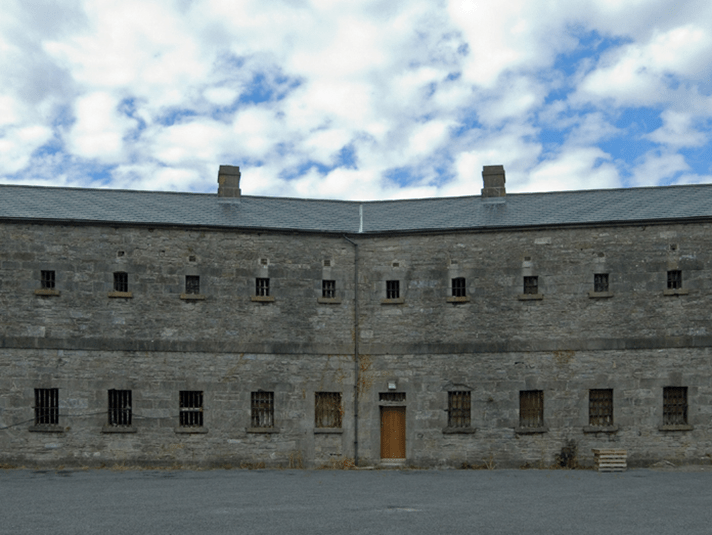
Sligo Jail
On Tuesday the 23rd of December the hearing resumed to hear from more witnesses. Once again Mr Monson J.P. presided, and District Inspector Moore conducted the case. Like the previous hearing the two prisoners were not professionally represented. The first person to be called was Mrs Mary Jane Tiernan, the nurse who had treated Rosa di Lucia. She stated that she had known the di Lucia’s for over twelve months, since she helped with the delivery of their baby Mary.
District Inspector Moore. “On that occasion did the di Lucia’s have a servant girl?”
Nurse Tiernan. “No.”
“Did you treat Mrs di Lucia during her last confinement?”
“Yes. On the 30th of November last I attended Mrs di Lucia when a female child was born.”
“How was the birth?”
“The birth was normal and there was no complications.”
“Was the servant girl, Jane Reynolds, there?”
“She was in the house.”
“After the birth how many times did you visit Mrs di Lucia?”
“A couple of times before Mr di Lucia called to my house on the Thursday night the 3rd of December. I accompanied him to his house where I found Dr Flanagan with Mrs di Lucia. She was feverish and did not seem well. She pointed to her head and said it felt bad. This occurred the following morning as well when I visited. Dr Flanagan was present then as well. Mr and Mrs di Lucia were speaking to each other in their own language, and I asked what Mrs di Lucia was saying to him. He said that when Dr Flanagan put his hand on her head it gave her relief. The next evening when I called at about five o’clock, Jane Reynolds was in the room with Mrs di Lucia, who appeared to be vexed. I asked what had vexed her and she said. The Boss. I sent for Mr di Lucia and asked why he had vexed his wife, and he told me that he had gone for potatoes and got delayed. They then commenced to speak in their own language, and I got the impression that they were both vexed with each other. I told Mr di Lucia he should have a woman there to mind his wife. On Monday the 7th of December I again visited with the deceased, and at about eleven o’clock Jane Reynolds came into the room. Mrs di Lucia was quite natural and taking some bread and coffee. I sent Jane Reynolds for water and then Mrs di Lucia seemed quite annoyed. I often saw her snapping things which were handed to her by Jane Reynolds and pitching them aside.”
“You dressed Mrs di Lucia on the Monday?”
“Yes.”
“And you saw blood stains on the centre of the sheet, which are not unusual?”
“Yes.”
“When you left Mrs di Lucia that day was she perfectly normal?”
“Yes.”
“That was the last time you saw her alive?”
“Yes.”
“Now, did Jane Reynolds call to your house on the Tuesday morning?”
“Yes.”
“At about what time did she call?”
“At about half ten.”
“What did she say to you?”
“She said the Missus was dead.”
“Did she do anything while she was saying this?”
“She clapped her hands.”
“Did you ask what happened?”
“Yes; she said. When I awoke at six o’clock in the morning I called on her to see if she wanted a drink, and I got no reply. I turned around and the blankets were over her face. On pulling down the blankets I saw the cut on her forehead and the hammer was beside the bed. I then said oh Jane she must have killed herself with the hammer and she replied that she had.”
“You then went with Jane Reynolds to the di Lucia’s house?”
“Yes.”
“Did she say anything on the way?”
“Yes. She said she was sleeping with her, and Mrs di Lucia left the room at about two o’clock and went down to the shop and drank four bottles of lemonade. She then said she brought up a fifth bottle and handed it to her, but she refused it and with that Mrs di Lucia threw half of it over her.”
“When you entered the bedroom you saw Mrs di Lucia lying dead on the bed?”
“Yes.”
“Where was Angelo di Lucia at this time?”
“He was lying across the foot of the bed crying.”
“What did you do then?”
“I pulled him away from the bed and asked why he had not sent for me.”
“What was his reply?”
“He said he didn’t think his wife would do that, which he repeated several times.”
“Now, was there a bandage across Mrs di Lucia’s forehead?”
“Yes.”
“Before you touched this bandage could you see any wound on her?”
“Yes; on her nose.”
“Did you pull up the bandage?”
“Yes; I did.”
“What did you then see?”
“I saw a wound on her forehead and on her temple.”
“What about the sheets?”
“The sheet I saw under the woman was there Monday.”
“What about Mrs di Lucia’s nightdress?”
“It was freshly put on.”
“Did you make any suggestion to Angelo di Lucia about getting a woman in to lay her out?”
“Yes; but he said he would do it himself.”
“What did you say to that?”
“I told him nothing could be done until after the doctor came.”
“Could you say if anything had been done to Mrs Lucia’s head before you came?”
“It had been washed.”
“Did you notice anything about the floor?”
“It had been washed between the bed and the fire.”
“You left then?”
“Yes; but I returned at about twelve o’clock.”
“Did you make an examination of Mrs di Lucia’s body?”
“Yes.”
“Did you find any more marks?”
“Only a scratch on her knee.”
“The statement Jane Reynolds made to you at your house, did she make it anywhere else?”
“Yes; in the di Lucia’s kitchen, I think the husband’s brother was there.”
“Now, were you in the di Lucia’s kitchen on Wednesday evening?”
“Yes.”
“Did Jane Reynolds come down the stairs to the kitchen?”
“Yes.”
“Did she say anything about Angelo di Lucia?”
“She said he had been arrested for the murder of his wife and while being arrested he said that he was innocent.”
“Did Jane Reynolds say anything about herself?”
“She said she was innocent also.”
“Did Jane Reynolds ever say anything about sleeping with Mrs di Lucia?”
“She said it was the first time.”
This concluded Nurse Tiernan’s evidence. Neither of the prisoners posed her any questions. The next witness called was Dr Flanagan, who stated that he had visited Rosa di Lucia every day after she had given birth.
District Inspector Moore. “Were you called in especially on Thursday night the 3rd of December?”
Dr Flanagan. “I was.”
“And what was the reason for that?”
“Her temperature had gone up. It was above one hundred.”
“Did you order anything to bring it down?”
“I prescribed for her. The dose was one teaspoon, and I arranged to see her again the next morning.”
“Had she improved on Friday morning?”
“Yes.”
“Did you see Mrs di Lucia make any motions with her hand?”
“Yes; a few times, she pointed at her temple.”
“And you gave her something?”
“Yes; a bromide mixture.”
“When did you next see her?”
“I again saw her on Saturday and Sunday.”
“Did she make any motion with her hand on those occasions?”
“I don’t believe she made any on Sunday.”
“Did you find anything in her condition which would go to show that there was something wrong with her head?”
“No.”
“In fact the only abnormal thing about her was the rising temperature?”
“Yes.”
“Did Angelo di Lucia interpret for you?”
“He did.”
“What did he say to you?”
“He gave me to understand that she was suffering from headache.”
“When did you see her next?”
“On Wednesday the 9th of December, the day of the inquest. I saw her dead body in her house.”
“Did you carry out a post mortem examination on the body?”
“I did.”
“When you left her on Sunday night had she any wounds about her head or face?”
“No; none whatever.”
Dr. Flanagan then provided a detailed explanation concerning the post-mortem examination. This was the identical testimony provided during the inquest.
District Inspector Moore. “Would the slight injury on the nose cause concussion?”
“No.”
“In your opinion would unconsciousness be caused by any of the three blows inflicted?”
“In my opinion any of them might have caused unconsciousness.”
“Did you form any opinion about the wounds being self-inflicted?”
“Yes I did. The wounds were not self-inflicted.”
“Were you handed a hammer on the day of the inquest?”
“Yes.”
“Did you compare the head of that hammer with the wounds on the head of the deceased?”
“I did. The curve of the head of the hammer and the curve of the wound corresponded.”
“Now, if that hammer had been wrestled by the deceased woman from the hands of her assailant, could it have caused any of those wounds?”
“Only the one on the nose.”
“To a certain degree violence would have to be used to cause the wounds on the head?”
“A certain amount.”
“Could you form a decided opinion as to how Mrs di Lucia was lying when she was struck?”
“No; I could not.”
“Could there have been a struggle?”
“Yes.”
“Which wound did you think bled?”
“The centre wound on the forehead was most likely to cause bleeding.”
“Did you find anything at all suggesting suffocation?”
“No; I did not.”
After the prisoners declined to ask Dr. Flanagan any questions, Coroner Dr. P.M. Quinn testified about the inquest he conducted into Rosa di Lucia’s death. He was then asked about their demeanour during their testimony.
“They were perfectly cool and knew what they were talking about.”
Once again the two prisoners had no questions. The hearing was then concluded after District Inspector Moore obtained a further remand of eight days.
The next hearing into the case took place on the 29th of December with the same principals, Again, the prisoners were not professionally represented. The first witness called was Martin McLoughlin, a shop assistant in Messrs Higgins and Keighton on Radcliffe Street. He stated that Jane Reynolds came into the shop between eight and nine o’clock on the 7th of December and bought a naggin of whiskey for “the ice cream man across the road”. The next witness was Myles Moran, a labourer, from Waste Gardens. He testified that he knew the di Lucia brothers and Jane Reynolds, and that he was a frequent visitor to the ice cream parlour at night. District Inspector Moore asked was he there the night that Mrs di Lucia had her baby.
“Yes; I heard about it and then I asked Jane Reynolds was it true. She said it was true and also said Angelo was mad about it.”
“Did you see Angelo di Lucia that night?”
“Yes; he came into the shop later and I congratulated him about the baby.”
“What did he say?”
“He said. To hell with it; three girls and no boy.”
“Did you hold a dance in your house?”
“Yes; about a month ago.”
“Did you invite Jane Reynolds?”
“Yes; before the dance began I went to the ice cream parlour and invited her. She said herself and Angelo would go after they closed the shop.”
“Did they turn up at the dance?”
“Yes; with Angelo’s brother Pasquali.”
“Did you hear Angelo di Lucia being called Joe?”
“Yes; we all call him that.”
“Did you ever see Angelo and Jane Reynolds out before?”
“No.”
“Was Mrs di Lucia ever in your house?”
“No, sir.”
“And was the night of the dance the only night Angelo di Lucia and Jane Reynolds were in your house?”
“Yes.”
A domestic servant who lived on Radcliffe Street, Jane Kennedy was next deposed. She stated that she knew both prisoners and knew Mrs di Lucia to speak to.
District Inspector Moore. “On Sunday the 29th of November were you in the kitchen of di Lucia’s house with Jane Reynolds and Mrs di Lucia?”
“Yes; I was.”
“Did you notice anything wrong with Mrs di Lucia?”
“She looked as if she had been recently crying.”
“Did you ask Jane Reynolds about anything?”
“No sir; but she told me Angelo had given Mrs di Lucia a few thumps for not peeling the potatoes.”
“Was he present at this time?”
“No; he was in the shop.”
“The following Sunday you were in the house again?”
“Yes, sir.”
“Did Jane Reynolds ask you to go up and see the baby?”
“Yes; she did.”
“And when you went up where was Mrs di Lucia?”
“She was in bed.”
“And where was her husband?”
“Sitting by the bed.”
“Did he say anything to you?”
“He asked me did I know the height of the fever went in this country and I told him I thought it was a hundred and one.”
“Did he stay long in the room after you came in?”
“For about two minutes.”
“Was Mrs di Lucia able to speak to you?”
“No.”
“What was the demeanour of Jane Reynolds and Mrs di Lucia?”
“I could not say but Jane Reynolds gave Mrs di Lucia medicine which she took against her will.”
“There was a circus in town some time prior to this, did you see the prisoners at it?”
“I did.”
“And this was at night time?”
“Yes.”
“Did you know if they ever went about together?”
“No; that was the only time I saw them.”
“Who looked after the children during Mrs di Lucia’s confinement?”
“Jane Reynolds.”
“Did you ask Jane Reynolds to go out with you on Sunday the 6th of December?”
“Yes; but she said she could not go out as she had to mind Mrs di Lucia.”
The final witness, Julia Keaveney, another domestic servant from Radcliffe Street, testified that she saw the two prisoners together in the Picture Theatre on Thomas Street on Wednesday afternoon, the 11th of November. District Inspector Moore then requested and obtained an eight-day extension for the prisoners’ remand.
On Thursday the 7th of January the hearing resumed, and the first witness called by District Inspector Moore was Canon Doorly. He stated that he was acquainted with the prisoners and had been summoned to the di Lucia’s house on the morning of the 8th of December.
District Inspector Moore. “Where was Mrs di Lucia when you entered her room?”
“She was lying in the bed with the clothes over her. Her face was not covered but her head was.”
“What was round her head?”
“There was a bandage tied around her head; much like a napkin.”
“Who was in the room at the time you got there?”
“The woman’s husband and the servant girl Jane Reynolds.”
“Could you see anything wrong with Mrs di Lucia’s face before you removed the bandage?”
“No.”
“What was the demeanour of the defendants?”
“The husband was kneeling at the side of the bed and crying very loudly while the girl was standing there. She seemed fairly calm. I touched Mrs di Lucia’s face and it felt warm. I thought she might be alive and I made up my mind to anoint her conditionally. For that purpose I asked the husband to leave the room. The girl remained.”
“Did you do anything with the bandage?”
“I removed it by pushing it up on her forehead and then I saw the wound on her forehead.”
“Could you say if the wound was staunched or bleeding?”
“The wound was not bleeding but there was a slight ooze.”
“Did you ask Jane Reynolds anything?”
“I asked her how she got the wound and she said she had been left to mind her and had fallen asleep and didn’t know.”
“Had you any further conversation with her?”
“I asked her why there was no blood on the bandage and she replied that she didn’t know.”
“Could you form an opinion to whether either of the two defendants had been drinking that morning?”
“I did not think they had.”
“Did you say that the poor woman had done something to herself?”
“No.”
“How long were you in the house?”
“A half an hour give five or ten minutes.”
The next witness, R.I.C. Sergeant Reilly, stated he called to the di Lucia’s house at about quarter past eleven on the morning of the 8th of December.
District Inspector Moore. “Had any report been made to the barracks regarding an incident at the di Lucia’s house?”
“No.”
“When you got to the house were the doors opened or closed?”
“Both street doors were closed.”
“Who let you in?”
“Pasquali di Lucia.”
“Did you see Jane Reynolds when you went in?”
“Yes; she was in the kitchen with a child in her arms, and there was another child in the cradle in the kitchen.”
“Did you ask Pasquali, in Jane Reynolds’s presence, any question?”
“Yes; I asked him was Mrs di Lucia dead. Both answered simultaneously. Yes, she was found dead at half past six today.”
“Did you see Angelo di Lucia?”
“Yes; when he came down the stairs.”
“Did he say anything?”
“Yes, he said. Death, I found her dead at seven o’clock this morning. I questioned him and he said she had been complaining with her head for the last ten days and had been attended by Dr Flanagan and Nurse Tiernan. I asked to see the body, and he went before me up the stairs crying.”
“On the first landing upstairs how many bedrooms are there?”
“Two; one at the back and one towards the front. There is a large comparatively empty room between the front bedroom and the street.”
“On the landing above that there is another bedroom?”
“Yes.”
“Was there beds and bedclothes in each of those bedrooms you went into?”
“Yes.”
“What kind of apparel was in the top bedroom?”
“Female apparel.”
“Did you follow Angelo di Lucia into one of these bedrooms?”
“Yes; into the front bedroom on the first landing. When entered I saw Mrs di Lucia’s dead body. She was lying on her back in bed and was covered with a blanket to the chin. I saw a contused wound on the centre of the nose and small scratches on both cheeks. There was a white bandage near her forehead and wrapped around her head. I pushed it up and I saw a semi-circular wound on the centre of the forehead. I replaced the bandage on the forehead. After I saw the wound I cautioned Angelo di Lucia, I told him that he was not obliged to say anything but anything he said may be given in evidence against him.”
“Did you ask him any questions after that?”
“No.”
“Did he make a statement to you a few minutes later?”
“Yes; he said he found her lying there, while pointing at the floor between the bed and the fireplace. He also said he had washed and cleaned her and washed the blood off the floor and pointing to the bed he said he had put her there. The floor between the fireplace and the bed showed signs of recent washing and there was a hearthrug lying over part of the floor which had been washed”
“Were there a couple of small tables there?”
“Yes and two chairs at each side of the fire.”
“Did you find any weapon in the room?”
“Yes a hammer.”
“Did you take possession of it?”
“Yes.”
“Did Nurse Tiernan come in while you were there?”
“Yes.”
“And did she unloosen the bandage on the deceased’s head?”
“Yes and I then saw a second wound on the left side of the forehead.”
“Did you go with Jane Reynolds to the bathroom on the top floor?”
“I did.”
“Did you find a sheet in the bath?”
“Yes.”
“Did Jane Reynolds make any remark about the sheet?”
“Yes; she said it was the sheet from Mrs di Lucia’s bed and that she had it on the rail of the stairs outside the bedroom.”
“Was there any blood marks on it?”
“Yes; it was heavily bloodstained at one corner and slightly bloodstained in the centre.”
“Were there any other articles in the bath?”
“Yes; there were several other bloodstained articles of clothing.”
“How much blood?”
“Some of them were pretty heavily bloodstained.”
“After Angelo di Lucia was arrested did you take possession of his clothes?”
“Yes.”
“And did you examine them?”
“Yes. I found a small speck of blood on the right sleeve of his shirt; near the cuff.”
“When you got to the house did you see any whiskey there?”
“Yes; a naggin bottle on the table which was almost full. There was also a drinking glass on the table with about a half a glass of whiskey in it.”
Head Constable Murphy, who had been deposed on the 10th of December, was then recalled and his deposition was read back to him.
District Inspector Moore. “After that investigation on the 10th of December, did Jane Reynolds make any further statements to you?”
“Yes sir.”
“Was it on the same day?”
“Yes sir.”
“Did you write it down as she made it?”
“Yes sir.”
“Was Angelo di Lucia present?”
“No; he was not.”
“Tell us the statement.”
“She said. Head Constable, after Mr di Lucia coming into the room in his shirt and threw himself across his wife’s chest, he was across her over fifteen minutes before he had her killed and when he got off her he asked me had I any whiskey left for him. I asked him what he wanted it for and he said for himself. Of course he did the rest with his wife, cleaned her, washed her and laid her out.”
District Inspector Moore then asked Head Constable Murphy whether he had accompanied him to the di Lucia’s house the previous night.
“Yes.”
“Did you go into the front bedroom on the first floor?”
“Yes.”
“You closed the door?”
“Yes.”
“Did you hear the description here of Pasquali di Lucia of the noise he heard on the night of the murder?”
“Yes.”
“Did you say the words Oh! Oh!! Oh!!!As described by him?”
“Yes.”
“Did you say them three times?”
“Yes.”
“The first time you said the words they were fairly loud?”
“Yes.”
“The second fairly low?”
“Yes.”
“And the third time?”
“The first three Ohs’s were fairly loud and the second three fairly low.”
“On the first two occasions your door was closed?”
“Right, sir.”
“The third occasion it was open?”
“Practically open.”
Angelo di Lucia then asked Head Constable Murphy who had given Jane Reynolds the money to buy the naggin of whiskey.
“I don’t know.”
“Did I ask Jane Reynolds who struck my wife three times in the face with the hammer?”
“I don’t know.”
District Inspector Moore was then himself deposed.
“I was in the police barrack on the 10th of December while Head Constable Murphy was making his deposition in this case. After his direct evidence concluded, Mr Wilson, the C.P.S, asked the male prisoner had he any question to ask the Head Constable. Angelo di Lucia then made use of some words that I did not properly catch, as I was standing at the other side of the room from him. He was again asked by Mr Wilson whether he had any questions. The prisoner then asked the Head Constable. Did the girl tell you she took the hammer and struck my wife three times on the head. Jane Reynolds immediately turned towards di Lucia and said. You know I did not strike her with the hammer, to which he made no reply. Last night I went to di Lucia’s house with Head Constable Murphy. The front and back bedrooms on the first floor are ten and a half feet apart, connected by a landing with a rise of two steps to the front bedroom. There is a gas jet over the fire in the front bedroom in working order. There is a gas jet on the landing between the rooms and also one in the back bedroom. When only the jet in the front bedroom is lit there is a sheen of light reflected into the back bedroom when the doors of both bedrooms are open. From the door of the back bedroom you cannot look across the landing towards the front bedroom. There were beds in both bedrooms last night. I went into the back bedroom and closed the door. I could hear the Head Constables voice from the front bedroom on the first two occasions. On the third occasion the door of my room was open, and I could distinctly hear the sounds made by him in the front bedroom.”
After finishing his deposition the District Inspector asked Mr Monson J.P. to send both prisoners forward for trial at the next Assizes for the County of Sligo on the capital charges. His Worship acceded to the request, and both prisoners were returned for trial.

Green Street Courthouse, Dublin
The Sligo Assizes opened in the second week of March. After the two prisoners were arraigned, their counsels applied for a change of venue owing to the publicity the case had received in the town. The Crown did not oppose this request, resulting in a change of venue to Dublin for the next Assizes. However, this was postponed once more due to Jane Reynolds’s pregnancy. She gave birth in July, being one or two months pregnant at the time of Rosa di Lucia’s death.
The trial commenced on Tuesday, November 2, 1915, before Mr. Justice Dodd and a city common jury. The Attorney General and King’s Counsel, Mr. John Gordon M.P., served as the chief prosecutor on behalf of the Crown, assisted by Mr. J.H. Powell King’s Counsel. Both defendants were represented by Mr. James Fitzgerald Kenny. The prisoners took their place on one of the back benches of the court accompanied by a warden and a wardress. Jane Reynolds held her infant while observing proceedings. Mr Gordon KC said he proposed to try the prisoners separately and that he would proceed first with the trial of Jane Reynolds. The wardress then took the infant from Jane Reynolds while she was arraigned to stand trial. She gave an appearance of calmness and confidence. When the charge of having wilfully murdered Mrs di Lucia was put to her she pleaded not guilty. Mr. Justice Dodd inquired of the Attorney General whether it was necessary for Angelo di Lucia to remain in court or if it would be more appropriate to return him to jail. It was subsequently decided to send him back to jail. Mr. Gordon KC then proceeded to open the case.
“This crime took place on the night of the 7th or the morning of the 8th of December 1914 in the town of Sligo. The reason the case is being heard here in Dublin is because the Crown considered that the defendants might not get a fair as trial in Sligo as here in Dublin, and consequently it was removed to the quiet calm atmosphere of a court in Dublin; where the jurors would be no way prejudiced and would have no desire except to find the truth. The reason why the case has taken so long to be tried was because the female defendant was pregnant and the Crown could not proceed until she was well enough to take her place in court for the trial.
On the evidence that will be submitted to you there can be no shadow of doubt whatever. And I believe you will come to the conclusion that the only two persons in the world who know how the murder took place are the two persons who have been arraigned. The dead woman was the wife of the male prisoner and the woman now on trial was a servant in the house of the di Lucia’s. Mrs di Lucia was murdered by having her skull fractured by blows of a hammer. The only persons in the house at the time were the two prisoners, the murdered woman, the brother of Mr di Lucia and two young children.
Mr and Mrs di Lucia were married about ten years ago and she was also Italian. She was about thirty years of age. They had carried out an ice cream business in Sligo for about three years. The prisoner is an Irishwoman from Ballymote. She had been in the employment of the di Lucia’s for about five months when the murder occurred. It appears that she was on considerably intimate terms with the husband of the murdered woman. He and she went to places of amusement and dance without the murdered woman. Mrs di Lucia gave birth to a child a week before her murder and had three children altogether. In the course of the evidence it will be stated that on the day before she met her death she was quite normal and making a good recovery.
I submit that the prisoner was present at the time of the murder and took part in it, and after the murder had been completed, she and the husband set about removing all traces of the crime as best they could. Neither of them told any person of the violence Mrs di Lucia suffered before she died, and nothing was done by them to indicate that anything except an accidental or natural death had taken place. The woman suffered three blows to her head which could have been inflicted by a hammer which was found in the room. Any one of them would have caused unconsciousness, her skull was fractured and a bandaged tied round her head.
On the night of the murder the brother of Mr di Lucia, who was living in the house, went up to his bedroom at about half past eleven, leaving his brother and the prisoner in the kitchen. The arrangement was that Jane Reynolds was to spend the night in Mrs di Lucia’s room looking after her and the husband was to sleep with his brother. Sometime during the night Pasquali di Lucia, the brother, heard his sister-in-law, the murdered woman say Oh! Oh!! Oh!!!Immediately afterwards the prisoner, Jane Reynolds, came out on the landing and called for the boss. The husband then left the room in which he had been sleeping with his brother. Pasquali di Lucia does not know what took place during that period of time. At about seven o’clock in the morning Jane Reynolds came into Pasquali’s room and told him that Mrs di Lucia was dead. He got up and went to his sister-in-law’s room where he saw his brother lying over the bed crying. A hammer was lying in the room and Pasquali thought he observed a place where the floor had just been washed. In a statement the prisoner stated that she fell asleep in a chair by the fire and Mrs di Lucia got up and killed herself with the hammer.
I do not know the opinion of Mrs di Lucia may have formed in regard to the friendship between her husband and Jane Reynolds. It is not necessary to prove all details by means of witnesses and if you come to a reasonable conclusion on the evidence you are bound to act upon it. You should not be influenced by feelings of sympathy whether the prisoner was a young woman or an old man, you should find your verdict based entirely on the evidence presented before you. It is indeed a melancholy thing that a young woman should be on trial for a crime of this nature, but these cases are not unknown. I cannot conceive of a more brutal or callous murder than to attack with a hammer a woman enfeebled in health and only recovering from the illness consequent of childbirth. All that the Crown asks of you is that you act conscientiously and fearlessly on the evidence that will be produced before you.”
The rest of the day’s proceedings was taken up with evidence given by Pasquali di Lucia, Canon Doorly, Sergeant Reilly, Dr Flanagan, Dr Quinn, Nurse Tiernan, Jane Kennedy and Head Constable Murphy. They all repeated the evidence they had given previously. At the conclusion of the day, Mr. Fitzgerald Kenny announced that he would not be calling any witnesses. The case was then adjourned until the following morning.
Upon the resumption of proceedings Mr. Fitzgerald Kenny delivered his speech on behalf of the defence.
“The motive for the murder of Mrs di Lucia alleged by the Crown was that the two prisoners were in love with each other and that the conspired to do away with Mrs di Lucia. If that was the motive and if it was established, I would submit that it would prove altogether too much, because it would bring home with damming force the guilt of Angelo di Lucia. If Angelo was anxious to get rid of his wife and if his hands are stained with his wife’s blood, what reason is there in believing that a young girl like Jane Reynolds took part in it. Why should Angelo di Lucia, a strong man of thirty years, need the assistance of a fragile girl of seventeen.
The defence that I submit is that Jane Reynolds had no hand, act or part in the killing of Rosa di Lucia. It is quite clear that Pasquali, the brother of Angelo, was keeping something back in his evidence, and the reason he has in doing so is because he knew if he told the whole truth the guilt of Angelo di Lucia would be established. It is clear that the girl has been acting from first to last to shield the Italian, and the statement she made at the inquest was made solely for that purpose. It is perfectly clear that these statements do not throw a suspicion of doubt upon her, and there is no evidence on which you can be driven irresistibly to the conclusion that she committed the crime.
I now come to the most painful thing in this painful case. I have to say some extremely hard things, as hard a thing I could say about a member of the Royal Irish Constabulary, the Head Constable who was examined before you. It gives me great pleasure first of all, to say in reference to Mr Moore, the District Inspector, that everything done by him in this case was done by an efficient officer and an honourable, upright and humane man. District Inspector Moore had not at the time any suspicion about Jane Reynolds. Being anxious to do his duty as a police officer, and in order to forge the chain around Angelo di Lucia, he sent for her and they were in his office for a considerable period of time. He told her that she had placed herself in an extremely awkward position by saying she was in the deceased woman’s room all night. Head Constable Murphy was also present and the conversation lasted for an hour. She told them the same story she had told at the inquest, but Head Constable Murphy was not satisfied. He followed her up to the railway station and brought her and her sister into a waiting room. He told you they were only in the room for about four minutes, and what was the result? For an hour with District Inspector Moore she told the same story she had told at the inquest. She was four minutes in the waiting room of the railway station and what condition was she in. Head Constable Murphy said she was in tears and her legs were barely able to support her, she called on her sister to lean on. What sort of torture must this girl have suffered? The Head Constable placed her under arrest and gave her the usual caution. I submit that, taking into consideration the circumstances under which the prisoner’s statement was procured it is an absolutely worthless document. I ask you to discredit it because it came from the lips of a girl in the near state of collapse, and because of this state she was more likely to make a false statement than a true one. One portion of the statement, which is unquestionably true, was to the naggin of whiskey, because a naggin of whiskey was found with a portion of it in a glass, and not a drop of it had been drunk. The prisoner was perfectly sober when the priest came in the morning. She should have taken District Inspector Moore’s advice, but she continued to shield the Italian.
The Crown will tell you it is a crime of love, a crime of passion, however, these crimes of love and passion are fortunately rare, but, unfortunately, not as rare in other countries. This crime bares an Italian trade mark rather than an Irish one. You have been asked to believe that this murderous assault was made by a young girl of seventeen. It should require overwhelming evidence to make you believe that a young girl committed this crime. It is not a woman’s crime; force is not a woman’s way. Unquestionably there was a struggle before the deadly blows were struck, but there was not a mark on the person of Jane Reynolds. I refer you to the question from Angelo di Lucia when the evidence of the Head Constable was being given before the magistrate. Did the girl tell you she took the hammer and struck my wife three times on the head? On the spur of the moment Jane Reynolds said. You know I did not strike her with the hammer. How did Angelo di Lucia know that Jane Reynolds never struck his wife with the hammer? The guilt of Rosa di Lucia’s blood is not on the hands of Jane Reynolds.”
Mr Powell made the closing statement on behalf of the prosecution.
“There has never been such an unfortunate prisoner who has made out a case so absolutely conclusive against herself than the girl in the dock. That Rosa di Lucia died as the result of the joint violence of the prisoners cannot be disputed in any way whatever. I cannot leave to rest the aspersions made against Head Constable Murphy, because in my judgement and in the judgement of the Attorney General, the Head Constable has done nothing for which he has reason to feel sorry for. He has merely discharged his duty in the most humane possible manner, and objection should be taken in the strongest terms to the stigma placed on him by accusing him of torturing the girl into making a confession in the waiting room of the railway station. The Head Constable is not responsible for the fact that this unfortunate girl was telling lies and endeavouring to shield herself from the consequences of her guilt. Her confession showed that she took part in the murder. She started it but was unable to finish it. She helped to kill this frail unfortunate woman and did not show much mercy to her. Therefore, if you think and believe honestly that she is guilty, I fail to see how any feelings of sympathy for her can deflect you from the path of duty.”
Mr Justice Dodd then gave his charge to the jury. He began by reviewing the evidence presented in detail, after which he stated.
“One of the points you have to bear in mind is that in all her statements Jane Reynolds said she never left the room during the night, or that di Lucia did not come in until the voice of Mrs di Lucia was heard exclaiming Oh! Oh!! Oh!!!With reference to the circumstances under which Jane Reynolds made her statement to Head Constable Murphy, I think it was the duty of the Head Constable to find out all he could. Unless some inducement was held out such confessions are evidence, however, the value of the evidence lies with the jury. In this case you can only find a verdict of manslaughter by disbelieving her statements and believing that there was a row between her and Mrs di Lucia and that Reynolds, in a sudden moment of passion, killed her.”
Mr Justice Dodd then sent the jury out to deliberate. After half an hour’s absence they returned, and the foreman asked a question.
“What would be the effect if we found that the prisoner was present during the murder, even though she took no part in the murder?”
Mr Justice Dodd. “According to Scripture, by consenting to death, she would be guilty of murder.”
“We are also anxious to know whether the nurse or doctor recommended that a person should have been in attendance with Mrs di Lucia on that particular night, and whether the accused had been sleeping in the room since the birth of the baby?”
“The evidence was that there was no need for any special attention to the woman, as she had gotten over childbirth. It was not, however, an unusual thing that a girl in the position of the accused would stay in the room to look after two babies.”
“Also, did the doctor state that the first blow the deceased suffered was sufficient to prevent her from resisting?”
“He did; he said each of the blows brought unconsciousness.”
The jury retired again, and on their return a half an hour later they pronounced a guilty verdict against Jane Reynolds with a strong recommendation for mercy. Mr Justice Dodd then sentenced Jane Reynolds to death and fixed the date and place of her execution as Thursday the 2nd of December in Sligo prison. Once the sentence of death had been passed Jane Reynolds became hysterical and cried out.
“Oh, I did not do it My Lord. He killed his wife. My Lord don’t hang me, I have a little child. I am found guilty, but I am not guilty at all. I have a father and three brothers at the front.”
The outburst caused a great deal of emotion in the court as many women present burst into tears. The court was cleared as Jane Reynolds was quietly removed through a private door and taken back to prison.
The following day a separate jury found Angelo di Lucia guilty of the murder of his wife, and he was too sentenced to hang. A few days later the Lord Lieutenant, Ivor Guest, ceded to the recommendation of mercy suggested by the jury at Jane Reynolds’s trial and commuted her sentence to penal servitude for life. Likewise Angelo di Lucia’s sentence was commuted a few weeks later.
From my book Lady Killers

 Pat Doran Author
Leave a comment